Deutsch
 English
 Magyar
 Polski
 Română
 Türkçe
 Українська
 Български
- Wage floor for temporary agency work (Seventh Ordinance, valid until 30.09.2027): €14.96 from 01.07.2026, €15.33 from 01.09.2026, €15.87 from 01.04.2027.
- Statutory minimum wage: €13.90 from 01.01.2026, €14.60 from 01.01.2027 (Fifth Minimum Wage Adjustment Ordinance).
- The wage floor applies to all temporary work agencies – including those not bound by collective agreements and those based abroad – and also during periods without assignment.
- Higher sector-specific minimum wages under the Posted Workers Act (AEntG) take precedence (§ 8(3) AEntG).
- Due by the 15th bank working day of the following month at the latest; breaches can lead to fines of up to €500,000.
Which minimum wage applies in temporary agency work?
Several minimum levels apply side by side to temporary agency workers (Leiharbeitnehmer). The highest one applicable to the assignment is always decisive:
| Minimum level | Legal basis | Amount | Applies to |
|---|---|---|---|
| Statutory minimum wage | § 1 MiLoG, MiLoV5 | €13.90 from 01.01.2026; €14.60 from 01.01.2027 | all employees |
| Wage floor for temporary agency work | § 3a AÜG, Seventh Wage Floor Ordinance | €14.96 / €15.33 / €15.87 | all temporary agency workers, during assignments and periods without assignment |
| Sector-specific minimum wage | § 8(3) AEntG | per sector | temporary agency workers performing work within its scope, e.g. care or building cleaning |
| Collectively agreed pay | DGB/GVP set of collective agreements | EG 1 to EG 9 | where bound by the collective agreement or through a reference in the employment contract |
Wage floor in temporary agency work: amounts and term
The wage floor is based on a proposal by the parties to the collective agreement, the GVP and the DGB unions, which the Federal Ministry of Labour and Social Affairs made binding on all temporary work agencies by statutory ordinance (§ 3a AÜG). The Seventh Ordinance on a Wage Floor in Temporary Agency Work (Siebte Verordnung über eine Lohnuntergrenze in der Arbeitnehmerüberlassung) entered into force on 01.07.2026 and applies until 30.09.2027:
| Period | Minimum gross pay per hour |
|---|---|
| 01.07.2026 – 31.08.2026 | €14.96 |
| 01.09.2026 – 31.03.2027 | €15.33 |
| 01.04.2027 – 30.09.2027 | €15.87 |
- Scope: all employers that assign employees as temporary work agencies – expressly including temporary work agencies based abroad for their employees working in Germany (§ 1 of the Ordinance).
- Even without an assignment: The temporary work agency must pay the minimum hourly pay for periods of assignment and for periods without assignment (§ 8(5) AÜG). It also applies if a comparable permanent employee at the client earns less.
- Due date: by the 15th bank working day (Frankfurt am Main) of the following month at the latest.
- Working time account: If there is a collectively agreed arrangement with a working time account, special due-date rules apply to surplus hours. The account may hold a maximum of 200 surplus hours, or up to 230 seasonally; surplus hours above 150 must be protected against insolvency, and hours above 91 must be paid out at the employee's request (§ 2(4) of the Ordinance).
The amounts are identical to the hourly pay of pay group 1 in the DGB/GVP set of collective agreements.
Statutory minimum wage 2026 and 2027
The general statutory minimum wage rose from €12.82 to €13.90 on 01.01.2026 and will rise to €14.60 gross per hour on 01.01.2027 (§ 1 Fifth Minimum Wage Adjustment Ordinance). The Minimum Wage Commission decides on adjustments every two years (§ 9 MiLoG).
For temporary agency workers, the statutory minimum wage is currently only a safety net: rules under the AÜG take precedence over the Minimum Wage Act (MiLoG) as long as they do not fall below the minimum wage (§ 1(3) MiLoG). As the wage floor is higher, it is the decisive minimum in temporary agency work.
Sector-specific minimum wages for temporary agency workers
If a temporary agency worker is employed at the client in work covered by a sector-specific minimum wage under the Posted Workers Act (Arbeitnehmer-Entsendegesetz), the temporary work agency must grant at least these working conditions – even if the client establishment itself does not fall within the scope (§ 8(3) AEntG). The GVP lists the following sectors, among others, as relevant to temporary agency work:
- care sector (Seventh Care Work Conditions Ordinance, Pflegearbeitsbedingungenverordnung, term until 30.09.2028),
- building cleaning, electrical trade, roofing trade, scaffolding trade, painting and varnishing trade,
- security staff at commercial airports, and training and further-education services under Social Code Books II and III (SGB II and III).
The amounts change with every ordinance. Check the currently applicable version before the assignment.
Worked example: wage floor versus minimum wage
A temporary agency worker without a reference to a collective agreement works 160 hours in October 2026.
- At least under the wage floor: €15.33 × 160 = €2,452.80 gross.
- Under the statutory minimum wage, it would be €13.90 × 160 = €2,224.00 – the difference of €228.80 must not be undercut in temporary agency work.
In addition, without effective application of a temporary agency work collective agreement, Equal Pay applies from the first day, and it is usually above the wage floor.
Who carries out inspections and what are the penalties?
- Inspections: Compliance is checked by the customs authorities (Financial Monitoring Unit to Combat Undeclared Work, Finanzkontrolle Schwarzarbeit, § 17(2) AÜG) and by the Federal Employment Agency as part of its inspections.
- Fine: Anyone who does not pay the minimum hourly pay, or does not pay it on time, risks fines of up to €500,000 (§ 16(1) no. 7b, (2) AÜG) and the permit.
- Records at the client: Because a wage floor ordinance applies, the user undertaking (Entleiher) must record the start, end and duration of the temporary agency worker's daily working time by the seventh calendar day at the latest and keep the records for two years (§ 17c(1) AÜG; fine of up to €50,000). More on this in the article Timesheet.
- Documents at the temporary work agency: The documents for inspections must be kept available in Germany in German (§ 17c(2) AÜG).
Common mistakes
- The increase on 01.09.2026 or 01.04.2027 is not implemented for all employees.
- Periods without assignment are paid below the wage floor.
- A higher sector-specific minimum wage, for example in care, is overlooked.
- The working time account exceeds the limits of the Ordinance, or surplus hours above 150 are not protected against insolvency.
- For mini-jobs (Minijobs), it is not checked whether the hours still fit within the earnings limit after the increase.
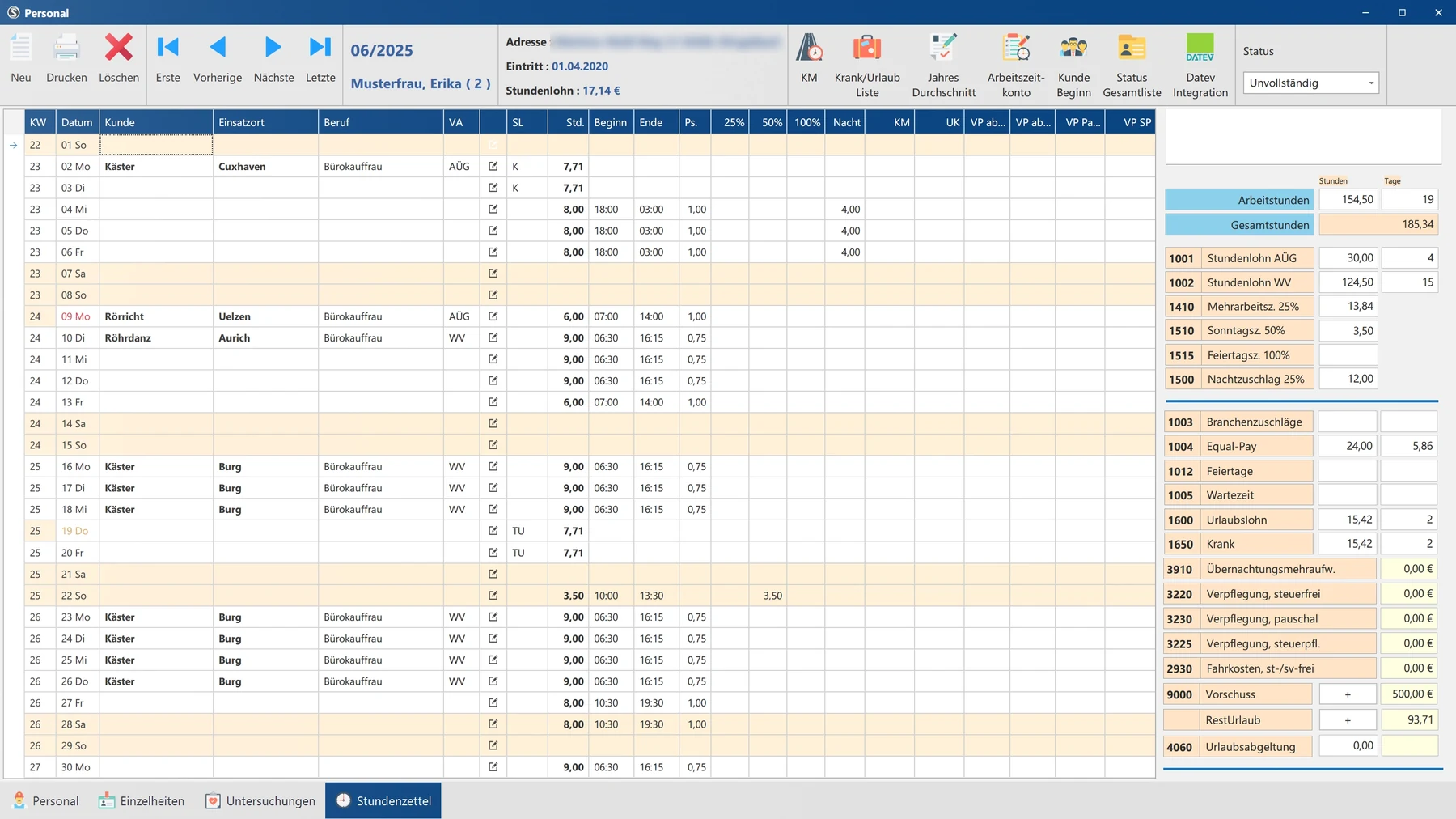
Our SBM staffing software shows how collectively agreed and minimum rates are maintained with an effective date and transferred to payroll preparation.
- § 2 Seventh Ordinance on a Wage Floor in Temporary Agency Work
- § 1 Seventh Ordinance on a Wage Floor – scope
- § 1 Fifth Minimum Wage Adjustment Ordinance (MiLoV5)
- § 1 Minimum Wage Act (MiLoG)
- § 3a AÜG – Wage floor
- § 17c AÜG – Preparation and storage of documents
- § 8 Posted Workers Act (AEntG)
- GVP: Minimum wages in temporary agency work
Note: This article does not replace legal advice. Last updated: 29.10.2026.