Deutsch
 English
 Magyar
 Polski
 Română
 Türkçe
 Українська
 Български

Equal Pay means that temporary agency workers (Leiharbeitnehmer) receive the same pay as comparable employees of the client. By law, this applies from the first day. The well-known periods of nine and fifteen months only apply if a collective agreement for temporary agency work is applied.
This article explains the rule, its exceptions and the typical mistakes made in practice.
Principle: Equal Pay from the first day
The principle of equal treatment (Gleichstellungsgrundsatz) is laid down in § 8 Abs. 1 AÜG (Arbeitnehmerüberlassungsgesetz, the German Temporary Agency Work Act). Under this provision, the temporary work agency (Verleiher) must grant the temporary agency worker, for the duration of the assignment, the essential working conditions, including pay, that apply to a comparable employee of the user undertaking (Entleiher).
„Der Verleiher ist verpflichtet, dem Leiharbeitnehmer für die Zeit der Überlassung an den Entleiher die im Betrieb des Entleihers für einen vergleichbaren Arbeitnehmer des Entleihers geltenden wesentlichen Arbeitsbedingungen einschließlich des Arbeitsentgelts zu gewähren (Gleichstellungsgrundsatz).“ [The temporary work agency is obliged to grant the temporary agency worker, for the period of the assignment to the user undertaking, the essential working conditions, including pay, that apply in the user undertaking’s establishment to a comparable employee of the user undertaking (principle of equal treatment).]
Nine months – only with a collective agreement
A collective agreement may deviate from the principle of equal treatment (§ 8 Abs. 2 AÜG). For pay, however, this is only permitted for the first nine months of an assignment to the same user undertaking (§ 8 Abs. 4 Satz 1 AÜG).
The period starts on the first day of the assignment at the user undertaking. What matters is the user undertaking, not the activity.
Interruptions of no more than three months do not reset the period – not even if the employee worked at the same user undertaking via another temporary work agency in the meantime (§ 8 Abs. 4 Satz 4 AÜG).
For part-time work, calendar months count, not working hours.
Fifteen months – with industry supplements
A collective agreement may only deviate for longer than nine months if, after a familiarisation period of no more than six weeks, it provides for a gradual alignment with the comparable pay (Vergleichsentgelt) and pay that the collective agreement defines as equivalent is reached after 15 months at the latest (§ 8 Abs. 4 Satz 2 AÜG). This alignment is governed by the eleven collective agreements on industry supplements (Tarifverträge über Branchenzuschläge, TV BZ).
Whether a TV BZ applies depends on whether the client’s establishment where the work is carried out belongs to the industry concerned – whether the client is bound by a collective agreement (Tarifbindung) plays no role. In the metal and electrical industry, for example, skilled trade businesses (Handwerksbetriebe) are excluded.
From when the first supplement is due is governed by the respective TV BZ: in the metal and electrical industry from the first day of the assignment, in many other industries after six full weeks.
Example: assignment in the metal industryAn employee has been working at a metalworking company for ten months. The industry supplement under the TV BZ ME has been paid since the first day and rises in stages. Result: equivalent pay is reached after 15 months at the latest – not already after nine.
If supplements are not paidIf the industry supplement is not paid as provided for in the TV BZ, the temporary work agency owes the back payment. In addition, there is a risk of fines of up to €500,000 (§ 16 Abs. 1 Nr. 7a, Abs. 2 AÜG) and of consequences for the AÜG permit (AÜG-Erlaubnis). Any further consequences in the individual case should be examined from an employment law perspective.
Revolving-door clause (Drehtürklausel): Equal Pay from day 1
The deviation by collective agreement does not apply to temporary agency workers who left an employment relationship with the user undertaking – or with an employer belonging to the same group of companies (Konzern) – in the last six months before the assignment (§ 8 Abs. 3 AÜG). For them, Equal Pay applies from the first day.
What counts towards comparable pay?
What matters is the pay the temporary agency worker would receive if they were employed directly by the user undertaking. Total pay is compared – including allowances and special payments such as holiday pay and Christmas bonus (Urlaubs- und Weihnachtsgeld).
If the user undertaking has no comparable employee, a hypothetical comparison is made; if a collective agreement applies at the user undertaking, the corresponding pay group is decisive (Technical Instructions of the Federal Employment Agency on the AÜG [Fachliche Weisungen der Bundesagentur für Arbeit zum AÜG], No. 8.1).
The user undertaking must state the working conditions of comparable employees in the temporary agency work contract (Überlassungsvertrag) (§ 12 Abs. 1 AÜG). The temporary agency worker can request information from the user undertaking (§ 13 AÜG).
Four typical mistakes with Equal Pay
In practice, these mistakes lead to back payments again and again:
Period counted incorrectly
Interruptions of no more than three months do not reset the period – not even via another temporary work agency.
Revolving door overlooked
Anyone who was employed by the client in the six months before the assignment is entitled to Equal Pay from the first day.
Wrong industry assigned
Whether a TV BZ applies is decided by the industry of the client’s establishment – not by whether the client is bound by a collective agreement.
Comparable pay incomplete
Allowances and special payments are part of the comparison – not just the hourly wage.
FAQ on Equal Pay in temporary agency work
From the first day of the assignment (§ 8 Abs. 1 AÜG).
Yes. Calendar months count, not working hours.
Then a hypothetical calculation is made of what the temporary agency worker would earn if hired by the client. If a collective agreement applies there, the corresponding pay group is decisive.
The user undertaking must state the essential working conditions of comparable employees in the temporary agency work contract (§ 12 Abs. 1 AÜG). The temporary agency worker can request information from the user undertaking (§ 13 AÜG).
Yes. Special payments such as holiday pay and Christmas bonus are part of the comparable pay.
Anyone who does not grant Equal Pay or the collectively agreed industry supplement must make back payments. In addition, there is a risk of fines of up to €500,000 (§ 16 Abs. 1 Nr. 7a, Abs. 2 AÜG) and of consequences for the AÜG permit.
Equal Pay is a question of deadlines – and of data.
The rule is clear, its implementation is not: deadlines per employee and client, industry supplements under the collective agreement and the client’s comparable pay all have to fit together.
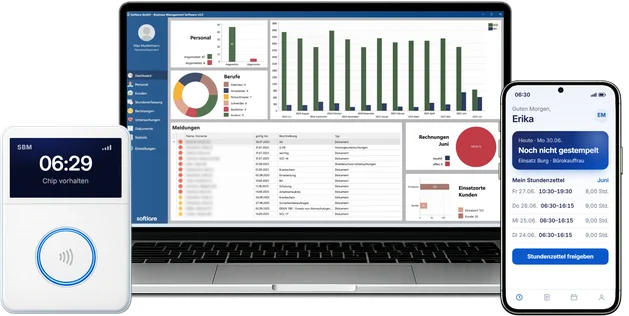
In SBM, you set the Equal Pay type per client. SBM determines the start and end for each employee and client and calculates with the comparable pay stored for the client.
Equal Pay & industry supplements in SBMAs of: October 2026. This article provides a general overview and does not replace legal advice. Sources: §§ 8, 12, 13, 16 AÜG; Technical Instructions of the Federal Employment Agency on the AÜG (Fachliche Weisungen der Bundesagentur für Arbeit zum AÜG); collective agreement on industry supplements in the metal and electrical industry (TV BZ ME).