Deutsch
 English
 Magyar
 Polski
 Română
 Türkçe
 Українська
 Български
- Trigger: leaving the user undertaking or a group company within the meaning of § 18 AktG no more than six months before the start of the assignment (§ 8(3) AÜG).
- Consequence: no deviation by collective agreement – Equal Pay and Equal Treatment from the first day and for the entire duration of this assignment.
- The type of termination does not matter: notice of termination, termination agreement or expiry of a fixed term.
- According to the Technical Instructions of the BA, the temporary work agency must clarify where the applicant was employed in the six months before the assignment.
- Anyone who does not grant equal treatment risks a fine of up to €500,000 and their permit (§ 16(1) no. 7a, § 3(1) no. 3 AÜG).
What does the revolving-door clause govern?
The revolving-door clause governs when a temporary agency work collective agreement may, by way of exception, not deviate from the principle of equal treatment. In principle, temporary agency workers are entitled to the essential working conditions of comparable permanent employees of the user undertaking (§ 8(1) AÜG), and a temporary agency work collective agreement may deviate from this (§ 8(2) AÜG). Anyone who left the client itself or its group in the six months before the assignment, however, receives the conditions of comparable permanent employees immediately.
The name refers to the image of a revolving door: out as a permanent employee, back in as a temporary agency worker. The clause only concerns the deviation by collective agreement; the permit, the maximum assignment period and the other obligations remain unaffected. It does not apply to temporary employment relationships established before 15.12.2010 (§ 19(1) AÜG).
What are the requirements of the revolving-door clause?
The clause applies when three features coincide (§ 8(3) AÜG):
- Previous employment relationship: The temporary agency worker was employed by the user undertaking itself, on a fixed-term or permanent basis.
- User undertaking or group: An employment relationship with a company that belongs to the same group within the meaning of § 18 of the German Stock Corporation Act (AktG) as the user undertaking is sufficient.
- Leaving within six months: The employment relationship ended in the six months before the new assignment – whether by notice of termination, termination agreement or expiry of a fixed term.
The clause only has practical significance if a temporary agency work collective agreement is applied. Without a collective agreement, the principle of equal treatment applies from the first day anyway.
How are the six months of the revolving-door clause counted?
The obvious approach is to count back six months from the first day of the new assignment: if the end of the previous employment relationship falls within this window, the clause applies according to its wording. The Technical Instructions (Fachliche Weisungen AÜG) do not contain a worked example on the revolving-door rule. You should have borderline cases with a difference of only a few days legally reviewed.
| Leaving the client (assumed) | First day of assignment as a temporary agency worker (assumed) | Result |
|---|---|---|
| 31.03.2026 | 04.05.2026 | a gap of around five weeks: the revolving-door clause applies |
| 30.09.2025 | 04.05.2026 | a gap of more than seven months: the collective agreement may deviate |
| 04.11.2025 | 04.05.2026 | borderline case exactly on the six-month line: have it legally reviewed |
| 30.04.2026 at a sister company of the client | 01.07.2026 | applies if both companies form a group under § 18 AktG |
| no employment contract with the client, only a previous assignment there as a temporary agency worker | 01.07.2026 | according to the wording, no revolving-door clause; however, the previous assignment counts towards the Equal Pay period if the break is up to three months |
What applies to group companies of the user undertaking?
The revolving-door clause extends beyond the individual client. Under § 18 AktG, companies under uniform management form a group – as controlling and dependent companies or on an equal footing. According to the Technical Instructions of the Federal Employment Agency, the AÜG concept of a group is independent of legal form; the companies therefore do not have to be stock corporations (Aktiengesellschaften).
This affects, for example, production, logistics or service companies under a common holding company. Anyone who left the logistics subsidiary three months ago and is now assigned to the production company of the same group falls under the clause.
What does the revolving-door clause mean for pay and costing?
If the clause applies, the temporary work agency (Verleiher) must grant Equal Treatment – according to the Technical Instructions, for the entire duration of the assignment to this user undertaking. A collective agreement on industry supplements (Branchenzuschlagstarifvertrag) does not help in this case, because it too is a collective agreement within the meaning of § 8(2) AÜG, and § 8(3) AÜG excludes its deviation. Because no exception under a collective agreement applies, the exception for the contract details under the wording of § 12(1) AÜG also no longer applies: the user undertaking must state the essential working conditions of comparable employees in the assignment contract.
Example: A warehouse worker resigns from a logistics company with effect from 31.03.2026. From 04.05.2026, he is to work there again via a staffing provider. A collectively agreed wage of €16.00, comparable pay at the client of €18.40 per hour and 160 hours per month are assumed.
- Without the revolving-door clause, the collectively agreed wage could be paid up to and including 03.02.2027; Equal Pay would apply from 04.02.2027.
- With the revolving-door clause, Equal Pay applies from 04.05.2026: €2.40 more per hour, i.e. €384.00 gross per month.
- Over the first nine months, this adds up to €3,456.00 gross, plus employer social security contributions and other pay components of the client.
In such cases, calculate the charge rate (Verrechnungssatz) on the basis of the comparable pay as early as the quotation stage. What is included in comparable pay is explained in the article Equal Pay in temporary agency work.
How do staffing providers check the revolving-door clause when hiring?
The temporary work agency must know the applicant's employers from the six months before the assignment. For this, the Federal Employment Agency names application documents with a CV, the personnel form (Personalbogen), the agency's own questionnaire and, in addition, a duty to notify in the employment contract. A possible procedure:
- Record all employers of the last six months with their leaving dates in the personnel questionnaire.
- Before each assignment, compare: is the client or one of its group companies among them?
- For group clients, request the list of affiliated companies and keep it up to date.
- If the clause applies: set Equal Pay from the first day and request the comparable pay before the assignment starts.
- Document the check and its result in the personnel file.
What are the consequences of a breach of the revolving-door clause?
- Back payment: Agreements that provide for worse working conditions than § 8 AÜG requires are invalid (§ 9(1) no. 2 AÜG). The temporary agency worker can claim the difference.
- Fine: Anyone who fails to grant a working condition under § 8(1) sentence 1 AÜG commits a regulatory offence; fines of up to €500,000 are possible (§ 16(1) no. 7a, (2) AÜG).
- Permit: Failure to grant it can lead to refusal or revocation of the permit (§ 3(1) no. 3, § 5(1) no. 3 AÜG).
Revolving-door clause, three-month break and 18 months compared
| Rule | Question to check | Consequence |
|---|---|---|
| Revolving-door clause (§ 8(3) AÜG) | Was the employee employed by the client or its group in the last six months? | Equal Pay from the first day |
| Interruption (§ 8(4) sentence 4, § 1(1b) sentence 2 AÜG) | Were there more than three months between two assignments at the same client? | The Equal Pay period and the maximum assignment period start again |
| Maximum assignment period (§ 1(1b) AÜG) | How long has the employee already been assigned to this client? | End after 18 months, unless a different rule applies |
The three-month rule is explained in the article Interruption of an assignment, the 18-month limit in the article Maximum assignment period.
Common mistakes with the revolving-door clause
- The personnel questionnaire only asks about the last employer, not about all employers of the last six months.
- Group companies of the client with a different company name are not recognised.
- A former permanent employee is scheduled with the client's standard rule – Equal Pay after nine months.
- Only industry supplements are paid instead of Equal Pay.
- The client only states the comparable pay after the assignment has started, and the first payroll runs have to be corrected.
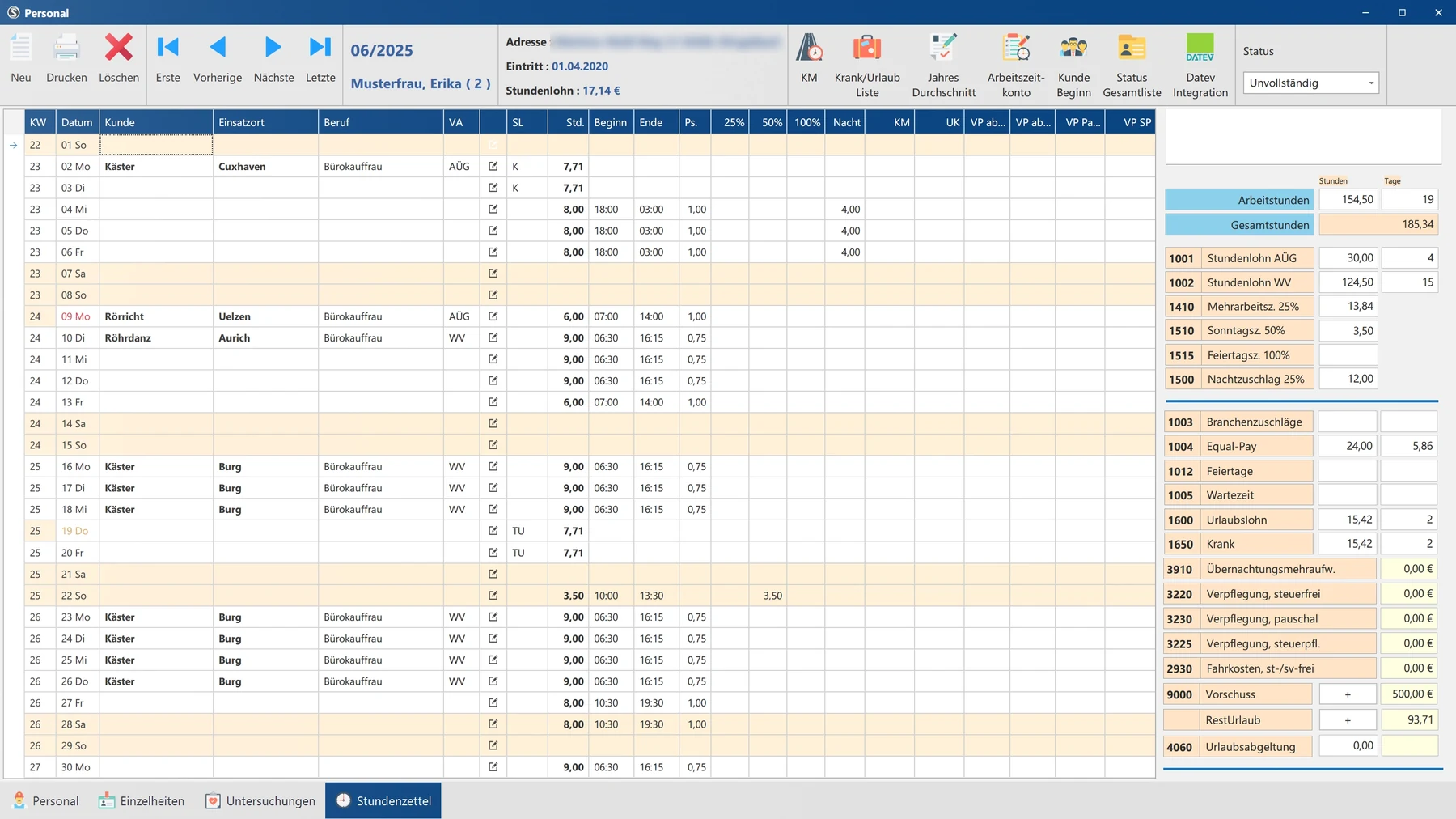
Our SBM staffing software shows how you define the Equal Pay type for each client and order.
- § 8 AÜG – Principle of equal treatment (subsection 3)
- § 18 AktG – Group and group companies
- § 9 AÜG – Invalidity
- § 12 AÜG – Legal relations between temporary work agency and user undertaking
- § 16 AÜG – Regulatory offences
- § 19 AÜG – Transitional provision
- Federal Employment Agency: Technical Instructions on the AÜG, No. 8.3 Revolving-door rule (valid from 01.07.2026)
- Federal Employment Agency: Information leaflet for temporary agency workers
Note: This article does not replace legal advice. Last updated: 29.10.2026.