Deutsch
 English
 Magyar
 Polski
 Română
 Türkçe
 Українська
 Български
- Anyone who assigns employees commercially needs a permit from the Federal Employment Agency (§ 1 AÜG).
- Maximum assignment period: 18 months at the same user undertaking (Entleiher) (§ 1(1b)); Equal Pay in principle from the first day, with a collective agreement after nine months (§ 8).
- The assignment contract requires text form and must expressly designate the assignment; the temporary agency worker must be specified in advance (§ 1(1), § 12).
- Infringements make contracts invalid and create an employment relationship with the user undertaking (§§ 9, 10).
- Fines of up to €500,000 – for example for breaches of Equal Pay or the wage floor (§ 16).
What does the AÜG regulate?
The Temporary Agency Work Act governs the triangular relationship between the temporary work agency (Verleiher), the temporary agency worker (Leiharbeitnehmer) and the user undertaking (Entleiher). It dates from 1972 and has been amended several times – fundamentally on 01.04.2017 with the maximum assignment period, Equal Pay after nine months and the disclosure obligation. Since 01.01.2025, text form instead of written form has been sufficient for the assignment contract.
The Act pursues two aims: it protects temporary agency workers – through the permit requirement, equal treatment and the wage floor – and keeps assignments temporary. How the Federal Employment Agency interprets the Act is set out in its Technical Instructions on the AÜG (Fachliche Weisungen AÜG; current version valid from 01.07.2026).
The key sections at a glance
| Section | Content | Practical significance |
|---|---|---|
| § 1 | Definition, permit requirement, maximum assignment period, disclosure and specification | Basis of every assignment; 18-month limit in subsection (1b) |
| § 1a | Notification instead of a permit | only for employers with fewer than 50 employees to avoid short-time work or redundancies |
| § 1b | Construction sector | assignment for work usually done by manual workers generally not permitted |
| §§ 2–5 | Granting, refusal, withdrawal and revocation of the permit | permit initially for one year, unlimited after three years; refusal in case of unreliability |
| § 3a | Wage floor | minimum hourly pay set by statutory ordinance for all temporary work agencies |
| § 7 | Notifications and information | report changes; keep business records for three years |
| § 8 | Principle of equal treatment | Equal Pay and Equal Treatment, deviation by collective agreement, revolving-door clause |
| §§ 9, 10 | Invalidity and legal consequences | deemed employment relationship with the user undertaking, declaration of continuation (Festhaltenserklärung) |
| § 11 | Temporary employment relationship | written statement of the contract terms, information leaflet, information before each assignment, occupational health and safety, strikes |
| § 12 | Contract between temporary work agency and user undertaking | text form, declaration on the permit, details provided by the user undertaking |
| §§ 13–13b | Rights vis-à-vis the user undertaking | information, vacancies, amenities and collective facilities |
| § 14 | Works constitution | involvement of the works council at the user undertaking (§ 99 BetrVG) |
| §§ 15–16 | Criminal and administrative fine provisions | fines of up to €500,000, imprisonment in serious cases |
| §§ 17–17c | Implementation and monitoring | Federal Employment Agency and customs; record-keeping obligation of the user undertaking |
| § 19 | Transitional provision | assignment periods before 01.04.2017 do not count |
Which deadlines and limits does the AÜG set?
| Rule | Period | Legal basis |
|---|---|---|
| Maximum assignment period at the same user undertaking | 18 consecutive months | § 1(1b) AÜG |
| Counting of earlier assignments | if there are no more than 3 months between them | § 1(1b) sentence 2, § 8(4) sentence 4 |
| Deviation from Equal Pay by collective agreement | for the first 9 months at most | § 8(4) sentence 1 |
| With a collective agreement on industry supplements | equivalent pay after 15 months at the latest, gradual alignment after no more than 6 weeks | § 8(4) sentence 2 |
| Revolving-door clause | 6 months after leaving the user undertaking | § 8(3) |
| Permit | initially 1 year; renewal application at least 3 months before expiry; unlimited after 3 years | § 2(4) and (5) |
| Business records of the temporary work agency | keep for 3 years | § 7(2) |
| Declaration of continuation | up to 1 month after the start or after the limit is exceeded | § 9(1) |
| Reply to a request to be taken on | within 1 month, from 6 months of assignment | § 13a(2) |
| Working time records kept by the user undertaking | by the 7th calendar day, keep for 2 years | § 17c(1) |
Who monitors compliance?
The Federal Employment Agency implements the Act in accordance with technical instructions from the Federal Ministry of Labour and Social Affairs (§ 17(1) AÜG). It grants permits, inspects permit holders and prosecutes, among other things, breaches of the maximum assignment period and of the principle of equal treatment. The customs administration (Financial Monitoring Unit to Combat Undeclared Work, Finanzkontrolle Schwarzarbeit) checks the wage floor and prosecutes, among other things, assignment without a permit and breaches of the designation and specification requirements (§ 17(2), § 16(3) AÜG).
What fines can be imposed?
| Maximum amount | Examples | § 16(1) AÜG |
|---|---|---|
| €500,000 | principle of equal treatment or collectively agreed conditions not granted, wage floor not paid, deployment in a business on strike, allowing foreign nationals without the required residence permit to work | nos. 2, 7a, 7b, 8a |
| €50,000 | working time records under § 17c missing or not kept for two years | no. 18 |
| €30,000 | assignment without a permit, missing designation or specification, exceeding the maximum assignment period, breach in the construction sector | nos. 1 to 1f |
| €2,000 | breach of the documentation and information obligations under § 11(1) and (2) | no. 8 |
In addition to a fine, the Federal Employment Agency may refuse or revoke the permit if the temporary work agency is unreliable (§ 3(1), § 5 AÜG). A temporary work agency that, without a permit, assigns foreign nationals who do not have the required residence permit commits a criminal offence (§ 15 AÜG).
Common mistakes in practice
- The assignment begins before the assignment contract exists in text form and the employee has been specified.
- The maximum assignment period and the Equal Pay deadline are calculated per assignment instead of per user undertaking – earlier assignments are not taken into account.
- The employment contract refers to only parts of a collective agreement; the deviation from the principle of equal treatment is then invalid.
- The information leaflet and the information about the user undertaking are missing from the personnel file.
- Business records cannot be produced for three years when the Federal Employment Agency carries out an inspection.
Working in compliance with the AÜG
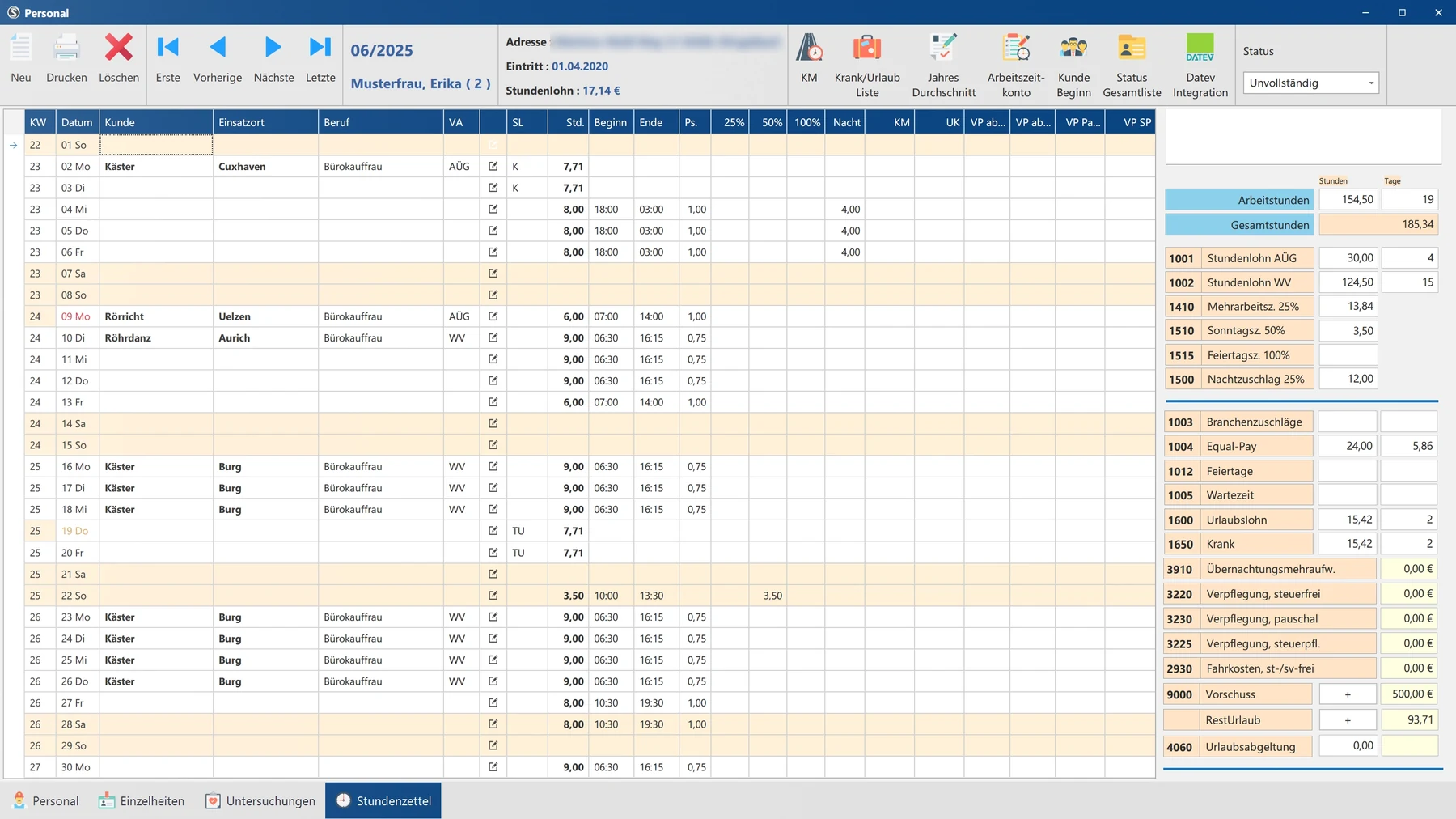
Most AÜG obligations depend on the individual assignment: who assigns whom, to which client, since when? Once this data is recorded properly in the assignment order, documents, deadlines and the start of Equal Pay can be derived from it. The page on our SBM staffing software shows how this works and gives an overview of the program.
- Temporary Agency Work Act (AÜG) – table of contents
- § 1 AÜG – Temporary agency work, permit requirement
- § 2 AÜG – Granting and expiry of the permit
- § 8 AÜG – Principle of equal treatment
- § 16 AÜG – Regulatory offences
- § 17c AÜG – Preparation and storage of documents
- Federal Employment Agency: Technical Instructions on the AÜG (valid from 01.07.2026)
- Act on Temporary Agency Work (official English translation)
Note: This article does not replace legal advice. Last updated: 29.10.2026.