Deutsch
 English
 Magyar
 Polski
 Română
 Türkçe
 Українська
 Български
- Eleven collective agreements on industry supplements, gradually in force since 01.11.2012; concluded with IG Metall, IGBCE, ver.di and EVG.
- The supplement is a percentage of the collectively agreed hourly pay and increases with the length of the assignment at the same client establishment.
- Statutory guard rails: gradual alignment after an induction period of no more than six weeks, equivalent pay after 15 months at the latest.
- The collective agreements on industry supplements continue to apply under the DGB/GVP set of collective agreements in force since 01.01.2026.
- What matters is the industry of the client establishment – it should be clarified and documented before the assignment begins.
What are industry supplements?
Temporary workers are paid under the temporary agency work collective agreement, i.e. according to the pay scale of the DGB/GVP set of collective agreements. In many manufacturing industries, the wages of permanent staff are considerably higher. Industry supplements are intended to narrow this gap as the assignment continues: they are added as a percentage of the collectively agreed hourly pay, and this percentage rises in stages the longer the employee works at the same client establishment.
For temporary agency work, industry supplements matter above all because of Equal Pay. According to the GVP, when a collective agreement on industry supplements is applied, pay for the entire assignment up to the maximum assignment limit is governed by that agreement; statutory Equal Pay after nine months then does not apply in principle.
Which collective agreements on industry supplements exist?
| Collective agreement | Industry | Union | In force since |
|---|---|---|---|
| TV BZ ME | Metal and electrical industry | IG Metall | 01.11.2012 |
| TV BZ Chemie | Chemical industry | IGBCE | 01.11.2012 |
| TV BZ Kunststoff | Plastics processing industry | IGBCE | 01.01.2013 |
| TV BZ Kautschuk | Rubber industry | IGBCE | 01.01.2013 |
| TV BZ HK | Wood and plastics processing industry | IG Metall | 01.04.2013 |
| TV BZ TB | Textile and clothing industry | IG Metall | 01.04.2013 |
| TV BZ Eisenbahn | Rail transport sector | EVG | 01.04.2013 |
| TV BZ PPK | Paper, board and plastics processing industry | ver.di | 01.05.2013 |
| TV BZ Druck | Printing industry (manual workers) | ver.di | 01.07.2013 |
| TV BZ PE | Paper-producing industry (manual workers) | IGBCE | 01.07.2014 |
| TV BZ KS | Potash and rock salt mining | IGBCE | 01.07.2014 |
The collective agreements on industry supplements were originally concluded by BAP and iGZ and passed to the GVP with the merger. They supplement the DGB/GVP set of collective agreements in force since 01.01.2026.
How do the stages work?
Each TV BZ sets its own stages: which percentage applies after which length of assignment. They share the statutory guard rails of § 8(4) sentence 2 AÜG:
- Induction period of no more than six weeks: After that, gradual alignment with the pay in the client's industry must begin.
- After 15 months at the latest, pay must at least reach a level that the parties to the collective agreement have set as equivalent to the collectively agreed wage of comparable employees in the client's industry (known as collectively agreed Equal Pay).
- Counting earlier assignments: For the 15-month limit, previous assignments to the same user undertaking (Entleiher) count if there were no more than three months between the assignments (§ 8(4) sentence 4 AÜG). How breaks affect the individual supplement stages is governed by the relevant TV BZ.
Some TV BZ also cap the supplement at a proportion of the pay of the client's comparable permanent employees (known as the cap, Deckelung). The exact percentages, stage dates and cap rules are set out in the text of the relevant collective agreement; the GVP provides pay tables with industry supplements to its members.
Worked example with an assumed percentage
An employee in EG 2b is assigned to an establishment in the metal and electrical industry. From 01.09.2026, the employee's collectively agreed hourly pay is €16.08. Assume that the relevant TV BZ provides for a supplement of 15% at the stage reached:
- Industry supplement: €16.08 × 15% = €2.41 per hour.
- Hourly wage including industry supplement: €18.49.
- For 160 hours a month: €385.60 gross more than without the supplement.
The percentage here is for calculation purposes only. Which stage applies at which point in time follows from the TV BZ of the client's industry.
Which TV BZ applies to an assignment?
The decisive factor is the sectoral scope of the relevant collective agreement, i.e. the industry of the client establishment in which the employee works. Because this classification is not always clear in day-to-day practice – for example in mixed-activity businesses – staffing providers should clarify it with the client before the assignment begins and record it in the assignment contract. If the client establishment does not fall under any of the eleven TV BZ, for example in retail or care, Equal Pay after nine months applies to pay.
Industry supplements, Equal Pay and the revolving-door clause
- Without a TV BZ: Equal Pay after nine months at the same user undertaking (§ 8(4) sentence 1 AÜG).
- With a TV BZ: industry supplements by stages, equivalent pay after 15 months at the latest (§ 8(4) sentence 2 AÜG).
- Revolving-door clause (Drehtürklausel): If the employee was employed by the user undertaking or a group company in the last six months, no deviation by collective agreement applies – i.e. Equal Pay from the first day (§ 8(3) AÜG).
Common mistakes
- The client's industry is not checked, and the assignment runs without a supplement – or with the supplement for the wrong industry.
- The change of stage is missed because the length of assignment is tracked manually in Excel.
- Earlier assignments at the same client are not counted.
- The supplement is calculated on the wrong basic wage, for example using the old hourly pay after a pay increase.
- The client's charge rate (Verrechnungssatz) is not adjusted when the stage changes.
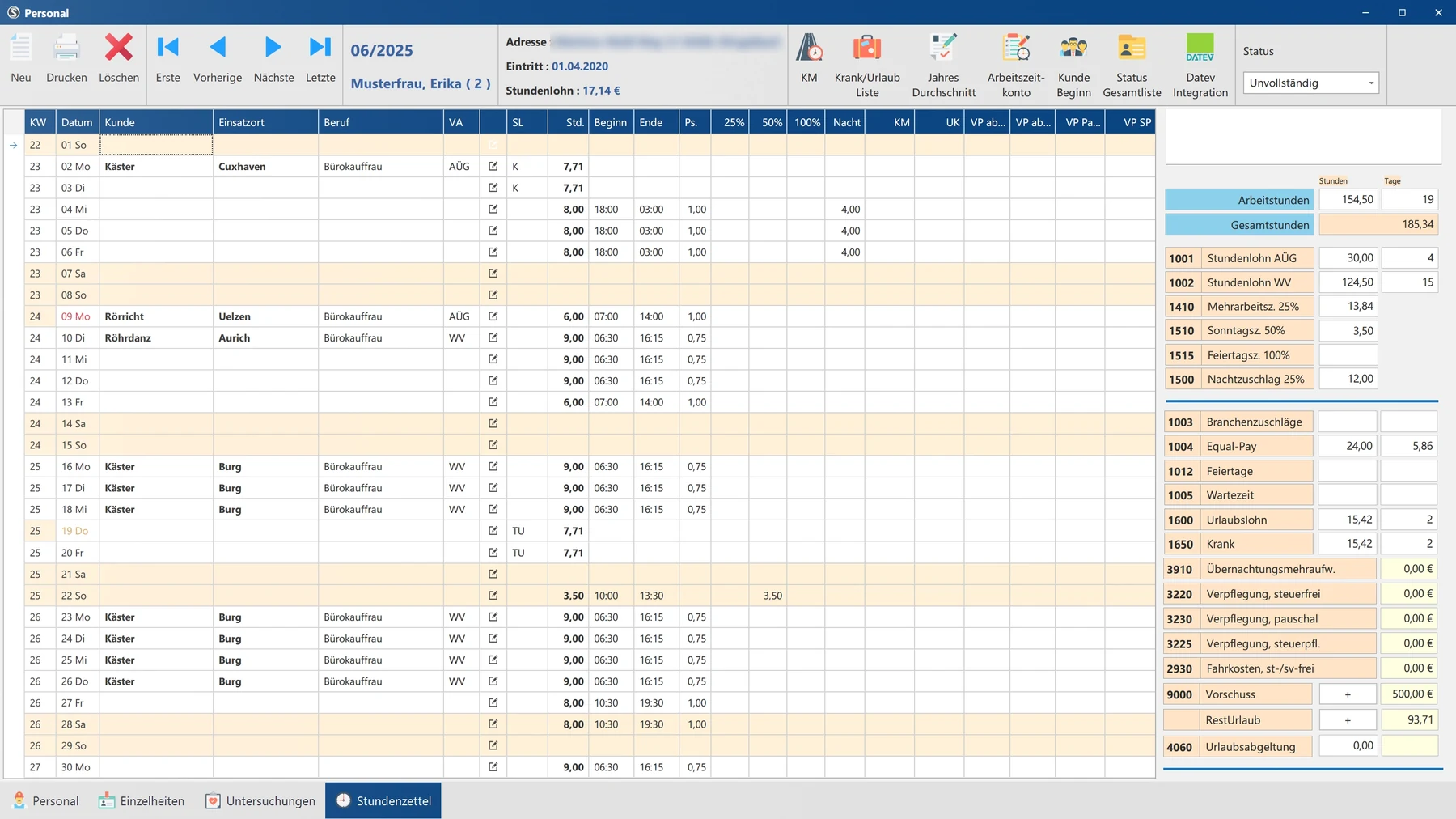
Our SBM staffing software shows how supplement stages are applied automatically for each employee and client.
- GVP: Collective agreements on industry supplements – overview of the TV BZ
- GVP: Pay tables under the DGB/GVP collective agreement
- § 8 AÜG – Principle of equal treatment
- Federal Employment Agency: Technical Instructions on the AÜG, No. 8.4 (valid from 01.07.2026)
Note: This article does not replace legal advice. Last updated: 29.10.2026.