Deutsch
 English
 Magyar
 Polski
 Română
 Türkçe
 Українська
 Български

Employers in Germany must record the working time of their employees. The Federal Labour Court (Bundesarbeitsgericht) ruled this on 13 September 2022 (BAG, 1 ABR 22/21) – based on the Occupational Safety and Health Act (Arbeitsschutzgesetz) and the judgment of the Court of Justice of the European Union of 14 May 2019 (CJEU, C-55/18).
There is not yet a dedicated law governing the form and details. In June 2026, the Federal Ministry of Labour (Bundesarbeitsministerium) presented a ministerial draft bill (Referentenentwurf) amending the Working Hours Act (Arbeitszeitgesetz, ArbZG); it has not been adopted (as of October 2026).
For staffing providers, the topic is doubly important: the recorded times are also the basis for pay, supplements and the invoice to the client. This article shows what applies today, what the draft provides for and how you can prepare.
The legal situation in four points
The obligation to record working time already exists – regardless of the planned law. These four points apply today:
Recording obligation since 2022
The start, end and duration of working time must be recorded (BAG 1 ABR 22/21). The system must be objective, reliable and accessible (CJEU C-55/18).
No prescribed form
Current law does not prescribe a particular form. Paper is also permitted at present, as long as the records are complete and reliable.
Retention
Records under § 16 Abs. 2 ArbZG and § 17 MiLoG (Minimum Wage Act) must be kept for at least two years.
Executive employees
Executive employees (leitende Angestellte) within the meaning of § 5 Abs. 3 BetrVG (Works Constitution Act) are exempt from the Working Hours Act (§ 18 Abs. 1 Nr. 1 ArbZG).
The 2026 ministerial draft – not yet law
Under the ministerial draft of the Federal Ministry of Labour of June 2026, time recording is to be regulated in the Working Hours Act (§ 16 ArbZG). According to specialist law firms, it provides for electronic recording with staggered transition periods and exceptions for small businesses.
The draft may still change during the legislative process. Only the promulgated law is decisive – until then, the current legal situation applies.
What also applies to staffing providers
Temporary agency work (Arbeitnehmerüberlassung) involves three parties. This has consequences for time recording:
Obligations at the client too
Under § 11 Abs. 6 AÜG, occupational health and safety rules – including working time law – also apply to the user undertaking (Entleiher).
Industries under § 2a SchwarzArbG
In industries such as construction, hospitality, transport or building cleaning (listed in the Act to Combat Undeclared Work, SchwarzArbG), the user undertaking must itself record the start, end and duration of working time – no later than the end of the seventh calendar day (§ 17 Abs. 1 MiLoG).
Times for payroll and invoicing
The same times are the basis for pay, supplements and the invoice to the client. Errors have a double effect.
Twelve points for your preparation
The following list is suitable as a template for an internal review. It should be possible to answer each point with “done” or “in progress”.
What is often overlooked in implementation
One recording method for all clientsA construction client needs mobile recording, an industrial client a fixed terminal, another client supplies its own time records. If you rely on only one method, your records will be incomplete for some of your assignments.
Maintaining payroll and invoicing separatelyThe recorded times are needed for payroll and for the invoice to the user undertaking. If you maintain both in separate systems, you maintain errors twice.
Waiting for the new lawThe obligation has existed since the BAG decision of 2022. In an inspection by the occupational safety authority (Arbeitsschutzbehörde) or customs (Zoll), you must already be able to present records today.
FAQ on mandatory time recording
Yes. Since the decision of the Federal Labour Court of 13 September 2022 (1 ABR 22/21), employers must record the start, end and duration of working time. A law governing the form exists as a ministerial draft of June 2026 but has not yet been adopted (as of October 2026).
Current law does not prescribe a particular form. What matters is that the recording is objective, reliable and accessible (CJEU C-55/18). The draft bill provides for electronic recording with transition periods in future.
Executive employees within the meaning of § 5 Abs. 3 BetrVG are exempt from the Working Hours Act (§ 18 Abs. 1 Nr. 1 ArbZG).
The temporary work agency (Verleiher) as the employer. Under § 11 Abs. 6 AÜG, however, occupational health and safety rules also apply to the user undertaking. In the industries under § 2a SchwarzArbG, the user undertaking must record working time itself (§ 17 Abs. 1 MiLoG).
At least two years (§ 16 Abs. 2 ArbZG, § 17 Abs. 1 MiLoG). Business records for the Federal Employment Agency must be kept for three years under § 7 Abs. 2 AÜG.
Breaches of recording obligations under the Working Hours Act and the Minimum Wage Act are administrative offences (Ordnungswidrigkeiten) and can be punished with fines (§ 22 ArbZG, § 21 MiLoG). Repeated breaches of occupational health and safety law can also call into question the reliability required for the AÜG permit (§ 3 Abs. 1 Nr. 1 AÜG).
The obligation already applies – the law will follow.
Staffing providers should not wait for the new law: times must be recorded today, and the same times are the basis for pay, supplements and invoicing.
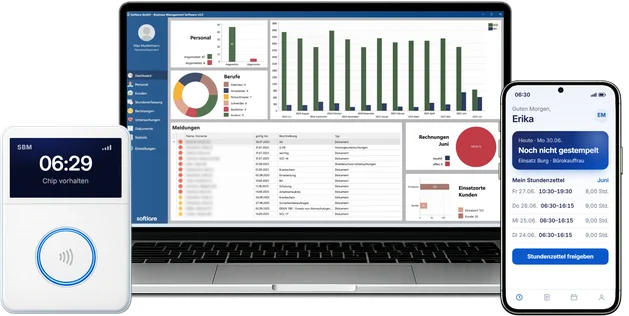
SBM records the times via terminal and employee app. After approval, they appear in the timesheet (Stundenzettel) – with automatically split supplements and handover to DATEV or Addison.
See time tracking with SBMAs of: October 2026. This article provides a general overview and does not replace legal advice. Sources: BAG, decision of 13.09.2022 – 1 ABR 22/21; CJEU, judgment of 14.05.2019 – C-55/18; §§ 4, 16, 18, 22 ArbZG; §§ 17, 21 MiLoG; §§ 3, 7, 11 AÜG.