Deutsch
 English
 Magyar
 Polski
 Română
 Türkçe
 Українська
 Български
- Employers must record working time (BAG, 13.09.2022) – so far, the form is free: paper, Excel, app or terminal.
- The law requires the start, end and duration of daily working time; for mini-jobs and in sectors under § 2a SchwarzArbG, within seven days at the latest.
- Records must be kept for at least two years; breaches can cost up to €30,000.
- In temporary agency work, the client usually confirms the hours – they are the basis for pay and invoice.
- Free template: monthly timesheet (Excel, calculates automatically) and weekly timesheet (PDF).
What is a timesheet?
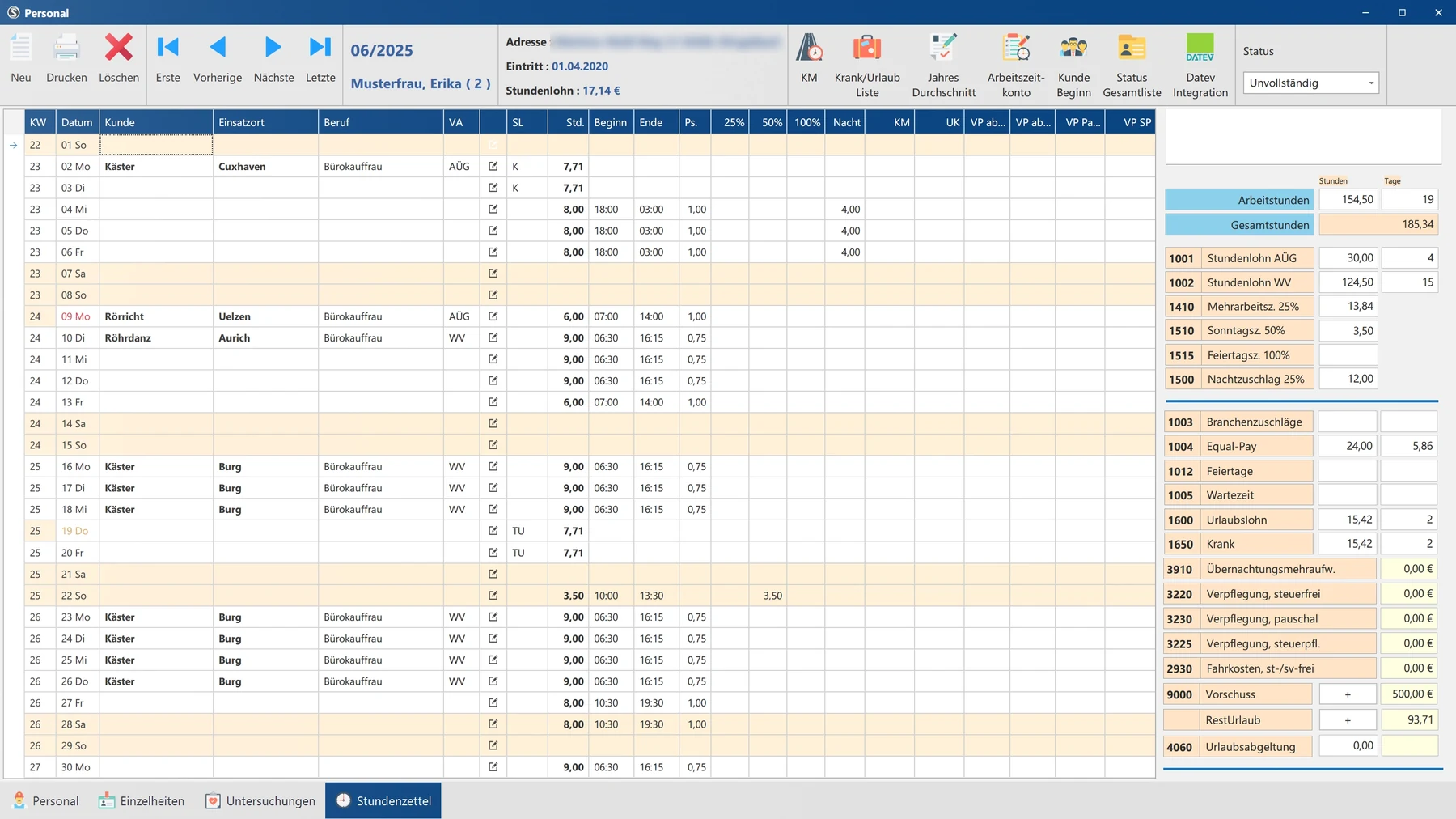
A timesheet – also called an hours record, working time record or activity record – documents when and for how long an employee worked: date, start, end, breaks and the working time calculated from them. It can be kept on paper, in Excel, via an app or using a time recording terminal.
In temporary agency work, the timesheet has a dual role. It is the basis for the temporary agency worker's payroll and at the same time for the invoice to the client business. Every hour that is recorded incorrectly, incompletely or too late therefore has a double impact.
Is a timesheet mandatory?
Yes. Employers in Germany must in principle record their employees' working time. In its decision of 13.09.2022 (1 ABR 22/21), the Federal Labour Court (Bundesarbeitsgericht, BAG) ruled that this obligation already follows from § 3(2) no. 1 of the Occupational Safety and Health Act (Arbeitsschutzgesetz, ArbSchG). The framework was set by the Court of Justice of the European Union (CJEU) in 2019 (judgment of 14.05.2019, C-55/18): the system must be objective, reliable and accessible.
In addition, special recording obligations apply:
- § 16(2) Working Hours Act (ArbZG): Working time that exceeds eight hours per working day must be recorded.
- § 17 Minimum Wage Act (MiLoG): For mini-jobs and in the sectors listed in § 2a of the Act to Combat Undeclared Work (Schwarzarbeitsbekämpfungsgesetz, SchwarzArbG) – such as construction, hospitality, freight forwarding, transport and logistics, building cleaning, trade fair construction and security services – the start, end and duration of daily working time must be recorded by the end of the seventh calendar day after the working day at the latest.
- Temporary agency work in these sectors: If temporary agency workers are assigned to one of these sectors, the recording obligation under § 17(1) sentence 2 MiLoG lies with the user undertaking (Entleiher), i.e. the client business.
Exactly how recording will have to be done in future – for example, whether it must be electronic – is to be specified in the Working Hours Act. Until then, the form is free as long as the records are complete, reliable and available for inspections. What staffing providers should implement now is summarised in our checklist on the 2026 time recording obligation.
What must a timesheet contain?
The law requires the start, end and duration of daily working time. For a timesheet in temporary agency work to also be usable for pay and invoicing, it should contain more:
| Detail | Why |
|---|---|
| Name and personnel number | clear assignment to the employee |
| Client (business of assignment) and place of work | basis for the invoice, Equal Pay and the maximum assignment period |
| Date, start and end | required by law |
| Breaks | proof of rest breaks under § 4 ArbZG |
| Duration of working time | required by law; basis for pay and invoice |
| Night, Sunday and public holiday hours | supplements for employee and client |
| Absences (holiday, sickness, public holiday) | continued pay and working time account |
| Signatures of employee and client | confirmation of the hours, fewer queries |
As a guide to breaks: for more than six hours of work, a break of at least 30 minutes is required; for more than nine hours, at least 45 minutes (§ 4 ArbZG). Working time per working day may generally not exceed eight hours, and no more than ten hours with compensation (§ 3 ArbZG). There must be a rest period of at least eleven hours between two working days (§ 5 ArbZG).
Timesheets in temporary agency work: what is different?
The temporary agency worker works at the client's premises but is employed by the staffing provider. This results in some special features:
- Hours are recorded at the client: The hours arise at the business of assignment and are usually confirmed by the contact person there. The staffing provider nevertheless needs them quickly and in full.
- One record, two settlements: The same hours produce the pay (pay grade, supplements, industry supplements (Branchenzuschläge), Equal Pay where applicable) and the client invoice (charge rate per hour plus supplements as agreed with the client).
- Different supplements: The collectively agreed supplements apply to the employee, the agreed surcharges to the client. Night, Sunday and public holiday hours must therefore be shown separately.
- The length of the assignment counts: Industry supplements increase with the length of the assignment, and Equal Pay generally applies after nine months at the same client (§ 8(4) AÜG), and after 15 months at the latest with a collective agreement on industry supplements – more on this in our article on the 9/15-month rule. A complete record per client helps to determine these deadlines reliably.
- Time pressure at month-end: Many employees at many clients mean many timesheets that have to be collected, checked and typed in before payroll.
How long must timesheets be kept?
Records under § 16(2) ArbZG and § 17 MiLoG must be kept for at least two years. If timesheets also serve as documents for payroll or as supporting documents for the client invoice, longer tax retention periods may apply: for example, the payroll account (Lohnkonto) must be kept until the end of the sixth calendar year after the last entry (§ 41 EStG), and accounting vouchers for eight years (§ 147 AO). Clarify the details with your tax adviser.
Anyone who breaches the recording or retention obligations under the Minimum Wage Act or the Working Hours Act risks a fine of up to €30,000.
Typical mistakes with paper and Excel timesheets
- Hours are typed in several times – from the sheet into Excel, then into payroll and once again into the invoice.
- Timesheets come back late, illegible or without the client's signature.
- Breaks are missing or do not meet the minimum breaks.
- Night, Sunday and public holiday hours are not separated – the supplements are then wrong in both pay and invoice.
- In Excel, formulas are overwritten, files are scattered and changes cannot be traced.
Free timesheet template: how to use it
Our templates are tailored to temporary agency work – with fields for the client, place of work, supplement hours and confirmation by the client. The templates are in German, as they are used at client businesses in Germany:
- Fill in the header: employee, personnel number, client, place of work, month and year.
- Enter start, end and break every day – in the Excel template, working time is calculated automatically, including for night shifts past midnight.
- Also enter night, Sunday and public holiday hours in the “davon …” (of which) columns.
- Record absences with a code (U = holiday, K = sick, F = public holiday, UU = unpaid leave, ZA = time off in lieu).
- Have the timesheet signed by the employee and the contact person at the client and pass it on to the scheduling team on time.
From paper to digital timesheets
A template helps you get started. But the more employees are on assignment, the more time collecting, checking and typing in at month-end takes. Hours recorded digitally – via an employee app or a time recording terminal – go straight into the system. Checks for missing days, unusually long shifts or hours on holiday days run automatically, and pay and invoice are created from the same data.
How this works in practice is shown by time recording in our SBM staffing software.
- BAG, decision of 13.09.2022 – 1 ABR 22/21
- CJEU, judgment of 14.05.2019 – C-55/18
- § 16 Working Hours Act (ArbZG)
- § 17 Minimum Wage Act (MiLoG)
- § 2a Act to Combat Undeclared Work (SchwarzArbG)
- § 8 Temporary Agency Work Act (AÜG)
Note: This article does not replace legal advice. Last updated: 23.10.2026.