Deutsch
 English
 Magyar
 Polski
 Română
 Türkçe
 Українська
 Български
- Principle: the same pay and the same essential working conditions as comparable permanent employees – from the first day (§ 8(1) AÜG).
- With a temporary agency work collective agreement: deviation on pay only during the first nine months at the same user undertaking (§ 8(4) AÜG).
- With a collective agreement on industry supplements: equivalent pay after 15 months at the latest.
- Earlier assignments at the same user undertaking count – including via other staffing providers – if there are no more than three months between them.
- Breaches: fines of up to €500,000 and a risk to the permit (§ 16(1) no. 7a, § 3(1) no. 3 AÜG).
What does Equal Pay mean?
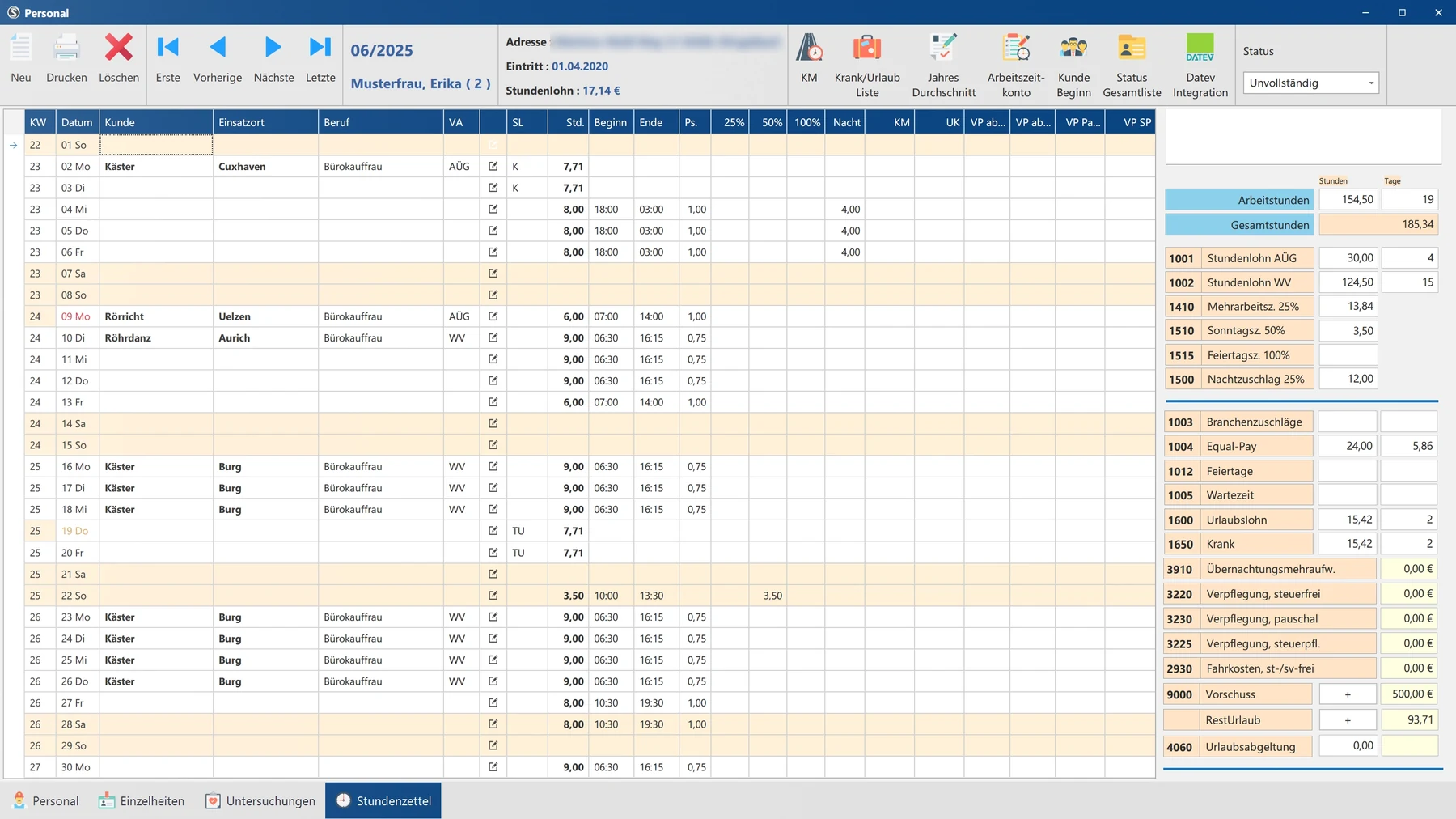
Equal Pay is part of the principle of equal treatment (Gleichstellungsgrundsatz) in § 8 AÜG. For the period of the assignment, the temporary work agency (Verleiher) must grant the temporary agency worker the essential working conditions, including pay, that apply to a comparable employee in the user undertaking's business. Equal Pay refers to pay, Equal Treatment to the other working conditions such as working hours, holidays, breaks or rest periods.
A collective agreement may deviate from the principle of equal treatment (§ 8(2) AÜG) – but on pay only for a limited time. In practice, Equal Pay is therefore above all a question of deadlines: from which day does the client's pay apply to which employee?
When does Equal Pay apply?
| Situation | Equal Pay from |
|---|---|
| No temporary agency work collective agreement applicable | the first day of the assignment |
| Temporary agency work collective agreement (e.g. DGB/GVP), no collective agreement on industry supplements | after nine months at the same user undertaking |
| Collective agreement on industry supplements applies | collectively agreed Equal Pay: equivalent pay after 15 months at the latest, gradual alignment after no more than six weeks |
| Employee left the user undertaking or a group company in the last six months (revolving-door clause, Drehtürklausel) | the first day of the assignment, for the entire assignment |
How industry supplements work in detail is explained in the article Industry supplements in temporary agency work.
How are the nine months calculated?
The period is calculated under § 187(2) and § 188(2) of the German Civil Code (BGB): it begins on the first day of the assignment, and that day counts. The Federal Employment Agency gives this example in its Technical Instructions (Fachliche Weisungen AÜG): if the assignment begins on 03.04.2026, pay may deviate until the end of 02.01.2027. Equal Pay applies from 03.01.2027.
- The same user undertaking counts, not the same establishment: What matters is the user undertaking as the employer. Assignments at different establishments of the same client are added together.
- Earlier assignments are counted: Previous assignments to the same user undertaking count in full – even if they ran via another temporary work agency – provided there were no more than three months between assignments in each case (§ 8(4) sentence 4 AÜG). Only a break of more than three months restarts the period.
- Part-time counts in full: The period depends on the agreed duration of the assignment, not on the hours worked.
- Part months: When several assignments are added together, the Federal Employment Agency counts a month as 30 days.
What is included in comparable pay?
Pay includes everything a comparable permanent employee receives on account of their employment – according to the Technical Instructions of the Federal Employment Agency, in particular:
- regular pay, allowances and supplements,
- holiday pay and continued pay during sickness,
- special payments and capital-forming payments (vermögenswirksame Leistungen),
- benefits in kind such as a company car that may be used privately – for this, the temporary work agency can pay cash compensation in euros (§ 8(1) sentence 3 AÜG).
The comparison is not made between individual components but between total pay over the assignment period. A comparable permanent employee is one with the same or similar work; if there is none, a hypothetical employee is used. If the temporary agency worker receives the collectively agreed pay that a comparable employee at the user undertaking receives under a collective agreement, Equal Pay is presumed to be met (§ 8(1) sentence 2 AÜG).
Where does the staffing provider get the data?
- From the user undertaking in the contract: The user undertaking must state in the temporary agency work contract (Arbeitnehmerüberlassungsvertrag) which essential working conditions, including pay, apply to comparable employees – unless an exception under a collective agreement in accordance with § 8(2) or (4) sentence 2 AÜG applies (§ 12(1) AÜG).
- Via the employee: The temporary agency worker can request information about these working conditions from the user undertaking (§ 13 AÜG).
- Ask in good time: It makes sense to request the comparable pay from the client in writing a few weeks before month nine – with the work, the pay grade and all pay components.
Worked example
An employee in EG 3 under the DGB/GVP agreement has been assigned to the same client since 03.04.2026; no collective agreement on industry supplements applies to the industry. From 01.09.2026, the collectively agreed pay is €17.11 per hour. A comparable permanent employee of the client earns €19.50 per hour (assumed figure).
- Up to and including 02.01.2027: collectively agreed wage of €17.11.
- From 03.01.2027: Equal Pay of €19.50 per hour, plus the permanent employee's other pay components.
- Additional cost on the hourly wage alone: €2.39 per hour, i.e. €382.40 gross per month for 160 hours – plus employer social security contributions.
For the staffing provider, this means aligning the charge rate (Verrechnungssatz) with the client in good time for the Equal Pay date.
What do the CJEU and the BAG say about deviations by collective agreement?
According to the Court of Justice of the European Union (CJEU), a collective agreement may treat temporary agency workers less favourably on pay if their overall protection is maintained, i.e. if compensating advantages offset the unequal treatment (judgment of 15.12.2022 – C-311/21). On 31.05.2023 (5 AZR 143/19), the Federal Labour Court (Bundesarbeitsgericht, BAG) ruled that a set of temporary agency work collective agreements met these requirements in the case decided – partly because of continued pay during periods without assignment, the wage floor and the limitation of the deviation to nine months in principle.
What are the consequences of breaches?
- Fine of up to €500,000 if the principle of equal treatment or the collectively agreed working conditions are not granted (§ 16(1) no. 7a, (2) AÜG).
- Permit at risk: Anyone who fails to grant temporary agency workers the working conditions under § 8 AÜG risks refusal or revocation of the permit (§ 3(1) no. 3, § 5 AÜG).
- Back payment: Agreements that provide for worse conditions than § 8 AÜG are invalid (§ 9(1) no. 2 AÜG); the employee can claim the difference.
Common mistakes
- The period is counted from a new order, although the employee had already worked at the same client with a break of less than three months.
- Assignments via another staffing provider are not asked about.
- Only the hourly wage is adjusted; the client's special payments, allowances and benefits in kind are missing.
- The revolving-door clause is overlooked because the personnel questionnaire does not record previous employers.
- The charge rate is not adjusted and the assignment becomes unprofitable from month ten.
Our SBM staffing software shows how the start of Equal Pay is calculated automatically for each employee and client.
- § 8 AÜG – Principle of equal treatment
- § 12 AÜG – Legal relations between temporary work agency and user undertaking
- § 13 AÜG – Temporary agency worker's right to information
- § 16 AÜG – Regulatory offences
- Federal Employment Agency: Technical Instructions on the AÜG, No. 8 (valid from 01.07.2026)
- CJEU, judgment of 15.12.2022 – C-311/21
- BAG, judgment of 31.05.2023 – 5 AZR 143/19
- § 187 BGB – Start of a period
Note: This article does not replace legal advice. Last updated: 29.10.2026.