Deutsch
 English
 Magyar
 Polski
 Română
 Türkçe
 Українська
 Български
- Triangular relationship: employment contract between the temporary work agency and the temporary agency worker (Leiharbeitnehmer), assignment contract between the temporary work agency and the user undertaking, right to give instructions with the user undertaking.
- Permit requirement under § 1 AÜG – without a permit, the contracts are invalid and an employment relationship with the user undertaking is deemed to exist (§§ 9, 10 AÜG).
- No more than 18 consecutive months at the same user undertaking; Equal Pay usually after nine months.
- The assignment contract requires text form, must expressly designate the assignment as temporary agency work and must specify the temporary agency worker in advance.
- To distinguish it from a contract for work (Werkvertrag) or a service contract (Dienstvertrag), what counts is how the contract is actually performed, not what it is called.
What is temporary agency work?
In temporary agency work, an employer provides staff to another company, where they are deployed like its own employees. The Act defines it as follows: employees are assigned to perform work if they are integrated into the work organisation of the user undertaking and are subject to its instructions (§ 1(1) sentence 2 AÜG). The legal basis is the Temporary Agency Work Act (AÜG).
The terms Zeitarbeit (temporary work), Leiharbeit (agency work), Personalleasing (staff leasing) and Mitarbeiterüberlassung (employee leasing) mean the same thing in practice. The Act speaks of the temporary work agency (Verleiher), the user undertaking (Entleiher) and the temporary agency worker (Leiharbeitnehmer); in the industry, the usual terms are staffing provider (Personaldienstleister), client (Kunde) and temporary worker (Zeitarbeitnehmer).
Whether there is an intention to make a profit is irrelevant. According to the Technical Instructions of the Federal Employment Agency (Fachliche Weisungen AÜG), non-profit organisations also fall under the AÜG if they provide staff on the market in return for payment.
How does the triangular relationship work?
| Relationship | Contract | What it governs |
|---|---|---|
| Temporary work agency – temporary agency worker | Employment contract | Pay, working hours, holidays, usually with reference to a temporary agency work collective agreement; the temporary work agency remains the employer and also pays during periods without assignment |
| Temporary work agency – user undertaking | Temporary agency work contract | Assignment in return for payment (charge rate, Verrechnungssatz), work, qualifications, working conditions at the client |
| User undertaking – temporary agency worker | No contract | The user undertaking gives the work instructions and is responsible for occupational health and safety at the place of work (§ 11(6) AÜG) |
What requirements apply?
- Permit: Anyone wishing to assign employees needs a permit from the Federal Employment Agency (§ 1(1) sentence 1 AÜG). It is initially granted for one year and can become unlimited after three years (§ 2(4) and (5) AÜG).
- Employment relationship with the temporary work agency: Only people employed by the temporary work agency may be assigned (§ 1(1) sentence 3 AÜG). Onward assignment by the user undertaking – known as chain assignment (Kettenverleih) – is not permitted.
- Temporary only: Assignment is permitted up to the maximum assignment period of 18 months (§ 1(1) sentence 4 and (1b) AÜG).
- Disclosure and specification: The temporary work agency and the user undertaking must expressly designate the assignment as temporary agency work in the contract and must specify the person of the temporary agency worker before the assignment (specification, Konkretisierung; § 1(1) sentences 5 and 6 AÜG).
- Text form: Since 01.01.2025, the contract between the temporary work agency and the user undertaking has required text form (§ 12(1) AÜG); previously, written form was required.
- Informing the employee: Before each assignment, the temporary work agency must inform the temporary agency worker that they will be working as a temporary agency worker and must give them the name and address of the user undertaking in text form (§ 11(2) sentence 4 AÜG).
- Construction sector: Assignment to construction businesses for work usually performed by manual workers is generally not permitted (§ 1b AÜG).
What rights do temporary agency workers have?
- The same essential working conditions as comparable permanent employees of the user undertaking – Equal Pay and Equal Treatment – unless a collective agreement deviates from this (§ 8 AÜG).
- At least the wage floor (Lohnuntergrenze), also during periods without assignment (§ 8(5) AÜG).
- Information from the user undertaking about the working conditions of comparable employees (§ 13 AÜG).
- Information about vacancies at the user undertaking and a reasoned reply to a request to be taken on after six months of assignment (§ 13a AÜG).
- Access to amenities or collective facilities such as the canteen, childcare or transport (§ 13b AÜG).
- An information leaflet from the permit authority when the contract is concluded, in their native language on request (§ 11(2) AÜG).
- No deployment as a strike-breaker in a business directly affected by a strike (§ 11(5) AÜG).
Temporary agency work, contract for work or service contract?
| Feature | Temporary agency work | Contract for work or service contract |
|---|---|---|
| Instructions to the workers | from the user undertaking | from the contractor (own staff) |
| Integration | into the client's work organisation | none; the contractor organises the work itself |
| What is owed | the provision of suitable workers | a work (result) or a service |
| Permit under the AÜG | required | not required |
Actual practice is decisive: if the contract and its actual performance contradict each other, the performance prevails (§ 12(1) sentence 2 AÜG). If a contract for work is in reality performed as an assignment (covert temporary agency work, verdeckte Arbeitnehmerüberlassung), the required designation is missing. In that case, the employment contract with the temporary work agency is invalid and an employment relationship with the user undertaking is deemed to exist, unless the employee objects in good time (§ 9(1) no. 1a, § 10 AÜG). In addition, fines of up to €30,000 may be imposed (§ 16(1) nos. 1c and 1d AÜG).
When does the AÜG not apply?
§ 1(3) AÜG largely exempts certain cases from the Act, including assignment between companies of the same group if the employee was not hired for the purpose of being assigned, and only occasional assignment between employers. Small employers with fewer than 50 employees may assign staff without a permit for up to twelve months to avoid short-time work or redundancies, provided they notify the Federal Employment Agency of the assignment in advance (§ 1a AÜG). Whether an exception applies should be checked case by case.
Common mistakes in practice
- The employee is deployed before the contract has been concluded and the employee has been specified.
- A ‘contract for work’ is concluded, but at the client's site the client's foreman gives the instructions.
- Earlier assignments at the same client – including via other staffing providers – are not counted towards the maximum assignment period and Equal Pay.
- The employee is not informed about the user undertaking in text form.
- The application to renew the time-limited permit is not submitted at least three months before it expires (§ 2(4) AÜG).
Temporary agency work in a staffing provider's daily operations
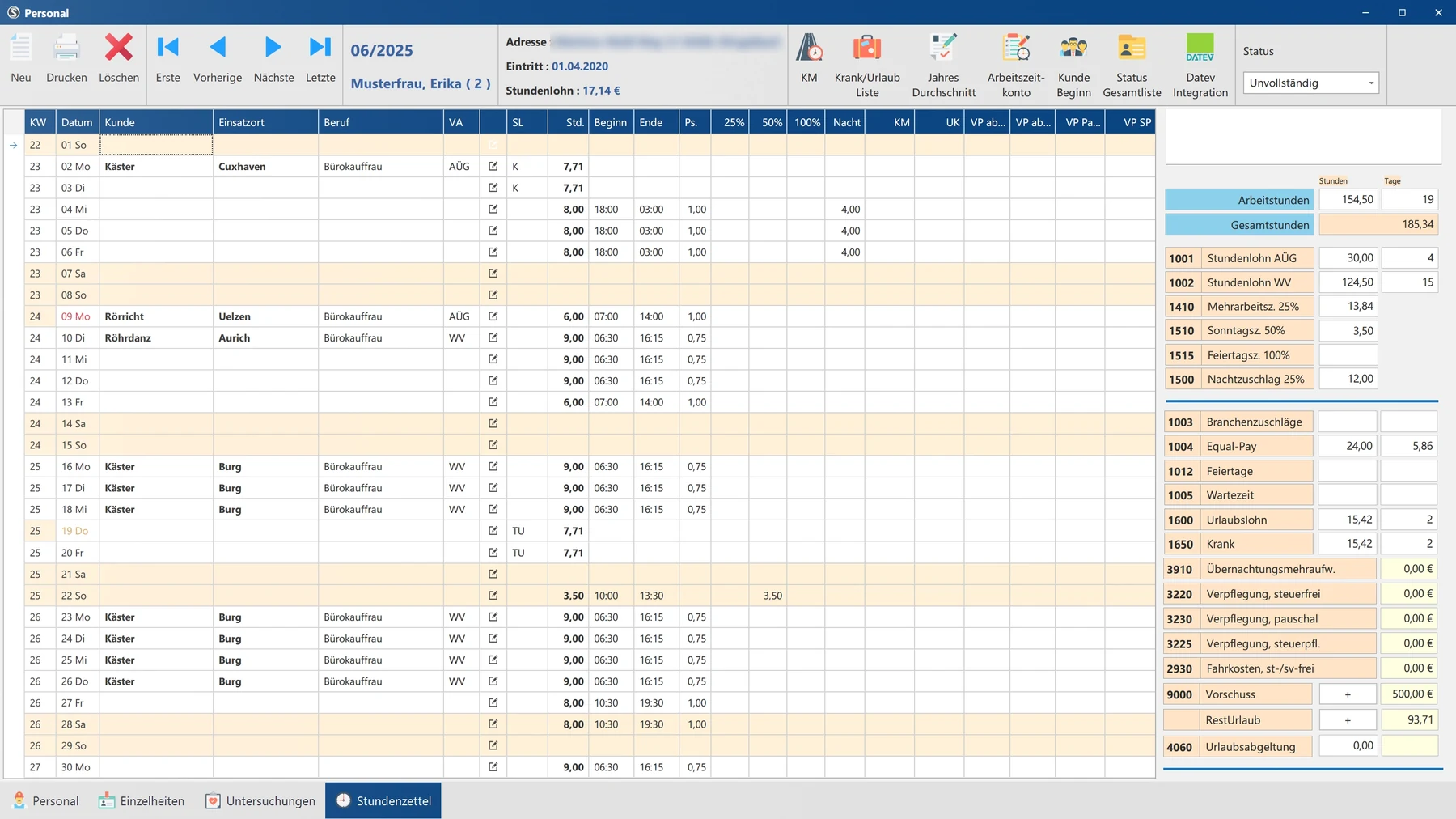
Every assignment creates obligations with deadlines: contract and specification before the start, Equal Pay after nine months, industry supplements in stages, end after 18 months at the latest. Our SBM staffing software shows how documents and deadlines can be managed from the assignment order.
- § 1 Temporary Agency Work Act (AÜG)
- § 1a AÜG – Notification of assignment
- § 1b AÜG – Restrictions in the construction sector
- § 9 AÜG – Invalidity
- § 10 AÜG – Legal consequences of invalidity
- § 11 AÜG – Other provisions on the temporary employment relationship
- § 12 AÜG – Legal relations between temporary work agency and user undertaking
- Federal Employment Agency: Technical Instructions on the AÜG (valid from 01.07.2026)
Note: This article does not replace legal advice. Last updated: 29.10.2026.