Deutsch
 English
 Magyar
 Polski
 Română
 Türkçe
 Українська
 Български
- Basic rule: no more than 18 consecutive months at the same user undertaking – calculated per temporary agency worker.
- Previous assignments count in full, including via other staffing providers, if each break is no longer than three months.
- Part-time work does not extend the period; what matters is the user undertaking as the employer, not the individual establishment.
- Deviations only through collective agreements in the client's industry or works agreements based on them; for user undertakings not bound by collective agreements, usually up to 24 months.
- Exceeding the limit: employment contract with the temporary work agency invalid, employment relationship with the user undertaking, fine of up to €30,000.
What is the maximum assignment period?
Temporary agency work is only permitted on a temporary basis (§ 1(1) sentence 4 AÜG). Since 01.04.2017, § 1(1b) AÜG has given this a fixed limit: the temporary work agency (Verleiher) may not assign the same temporary agency worker to the same user undertaking for more than 18 consecutive months, and the user undertaking may not let the worker work for longer. The obligation therefore applies to both sides.
The limit applies per temporary agency worker, not per job. Once it has expired, the client may fill the position with another temporary agency worker; the previous employee can be taken on by the client or assigned to another client. Assignment periods before 01.04.2017 are not taken into account (§ 19(2) AÜG).
How is the maximum assignment period calculated?
The period is calculated under § 187(2) and § 188(2) of the German Civil Code (BGB): it begins on the first day of the assignment, which counts, and ends 18 months later at the end of the day before the calendar day corresponding to the start date. The example given by the Federal Employment Agency (Bundesagentur für Arbeit): if 03.04.2026 is the first day of the assignment, the assignment is permitted until the end of 02.10.2027.
- The same user undertaking: This means the user undertaking as the employer. Assignments at different establishments or branches of the same client are added together.
- Contract, not hours: What matters is the agreed assignment period. A worker assigned three days a week uses up the same time as a full-time employee.
- Short recalls (Abberufungen) do not interrupt the running of the period.
- Part months: When several assignments are added together, the Federal Employment Agency counts a month as 30 days.
When do earlier assignments count?
Previous assignments to the same user undertaking are counted in full if there were no more than three months between the assignments in each case – regardless of whether they ran via the same or a different staffing provider (§ 1(1b) sentence 2 AÜG). The break itself does not count. Only a break of more than three months restarts the 18 months.
| Sequence | Period | Consequence |
|---|---|---|
| Assignment 1 | 01.02.2026 – 31.07.2026 | 6 months used |
| Break | 01.08.2026 – 31.10.2026 | exactly 3 months, i.e. no more than three months |
| Assignment 2 | from 01.11.2026 | assignment 1 is counted; 12 months remain, permitted until 31.10.2027 |
| Variant: assignment 2 | from 02.11.2026 | break longer than three months; the 18 months start again |
Because a single day can make the difference, breaks and assignment periods should be documented to the exact day. The same counting rule applies to the nine-month period for Equal Pay.
What exceptions and deviating rules are there?
- Collective agreement in the client's industry: The parties to collective agreements in the user undertaking's industry – including a company-level collective agreement (Haustarifvertrag) – can set a shorter or longer maximum period (§ 1(1b) sentence 3 AÜG).
- Works agreement (Betriebsvereinbarung) or public-sector service agreement (Dienstvereinbarung): User undertakings not bound by collective agreements but within the scope of such a collective agreement can adopt its rules with identical content (sentence 4). If the collective agreement contains an opening clause, works agreements can set their own maximum periods (sentence 5); user undertakings not bound by collective agreements may then go up to a maximum of 24 months, unless the collective agreement provides otherwise (sentence 6).
- Churches and religious communities can provide for deviating maximum periods in their rules (sentence 8).
- No deviation through temporary agency work collective agreements: The DGB/GVP set of collective agreements cannot extend the maximum assignment period. According to the Technical Instructions of the Federal Employment Agency (Fachliche Weisungen AÜG), any deviating rule must also state a specifically defined period.
What happens if the limit is exceeded?
- Invalid employment contract: When the limit is exceeded, the employment contract between the temporary work agency and the temporary agency worker becomes invalid (§ 9(1) no. 1b AÜG).
- Employment relationship with the client: At the same time, an employment relationship between the user undertaking and the temporary agency worker is deemed to exist (§ 10(1) AÜG).
- Declaration of continuation (Festhaltenserklärung): The temporary agency worker can prevent this by declaring in writing, within one month after the limit is exceeded, that they wish to continue the contract with the temporary work agency. The worker must first present the declaration in person at a local employment agency (Agentur für Arbeit) (§ 9(1) no. 1b, (2) AÜG).
- Fine of up to €30,000 (§ 16(1) no. 1e, (2) AÜG).
- Permit: Exceeding the limit can call the reliability of the temporary work agency into question; according to the Technical Instructions, however, a minor overrun in an individual case does not usually amount to unreliability.
What does the staffing provider need to establish?
The Federal Employment Agency expects the temporary work agency to clarify in each individual case which maximum period applies at the client and which earlier assignments must be counted. Ways of doing this include:
- a question in the personnel questionnaire about assignments at this client in recent months,
- a clause in the temporary agency work contract requiring the client to report earlier assignments,
- a reporting obligation in the temporary agency worker's employment contract.
The actual assignment periods of each temporary agency worker must be documented with suitable evidence in text form.
Common mistakes
- The period is counted per order instead of per user undertaking.
- A break of exactly three months is treated as a restart.
- Assignments via a previous staffing provider are not asked about.
- Reliance is placed on a supposed extension under the temporary agency work collective agreement.
- The client learns too late that the period is ending and has to reschedule at short notice.
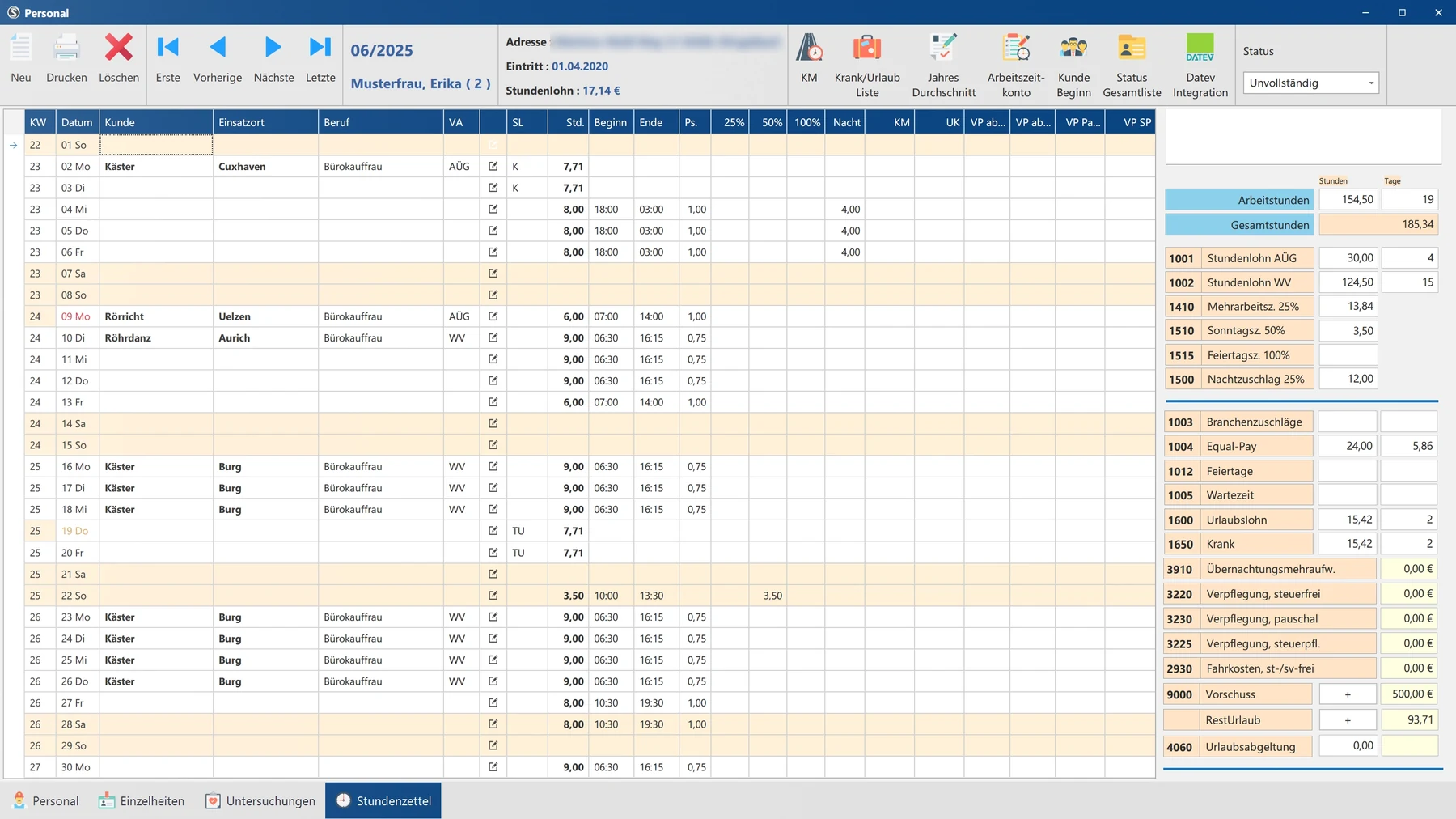
Our SBM staffing software shows how the maximum assignment period is stored for each client and transferred into the specification (Konkretisierung).
- § 1 AÜG – Temporary agency work, permit requirement (subsection 1b)
- § 9 AÜG – Invalidity
- § 10 AÜG – Legal consequences of invalidity
- § 16 AÜG – Regulatory offences
- § 19 AÜG – Transitional provision
- Federal Employment Agency: Technical Instructions on the AÜG, No. 1.5 (valid from 01.07.2026)
- § 187 BGB – Start of a period
- § 188 BGB – End of a period
Note: This article does not replace legal advice. Last updated: 29.10.2026.