Deutsch
 English
 Magyar
 Polski
 Română
 Türkçe
 Українська
 Български
- The temporary work agency is the employer of the temporary workers; the client (user undertaking, Entleiher) only gives the work instructions.
- No assignment without a permit from the Federal Employment Agency: initially limited to one year, possible without time limit after three years.
- Revenue comes from the charge rate (Verrechnungssatz) per hour; in addition, placement fees are permitted when the client takes on a worker.
- Core obligations: collective agreement or Equal Pay, wage floor, maximum assignment period, assignment contract in text form, informing employees.
- Wages are also owed during periods without assignment – this risk cannot be excluded by contract.
What is a temporary work agency?
A temporary work agency carries out temporary agency work: it hires employees on regular employment contracts and assigns them to clients that need staff temporarily – for example during peaks in orders, illness, projects or as a trial before permanent employment. In the Act, the temporary work agency is the Verleiher, the client is the Entleiher (user undertaking) and the employee is the Leiharbeitnehmer (temporary agency worker).
Many companies describe themselves as staffing providers (Personaldienstleister). The term is broader: besides temporary agency work, it often also covers recruitment (Personalvermittlung), contracts for work and service contracts, or on-site management.
How does a temporary work agency work?
- Client request: The client describes the work, qualifications, place of work, working hours and duration.
- Assignment contract: The temporary work agency and the client conclude a temporary agency work contract in text form, often as a framework agreement with individual assignments.
- Staff: A suitable employee is selected or newly hired; the employment contract usually refers to the DGB/GVP set of collective agreements.
- Before the assignment: specification of the employee to the client (Konkretisierung), informing the employee about the user undertaking in text form, occupational health and safety instruction at the client.
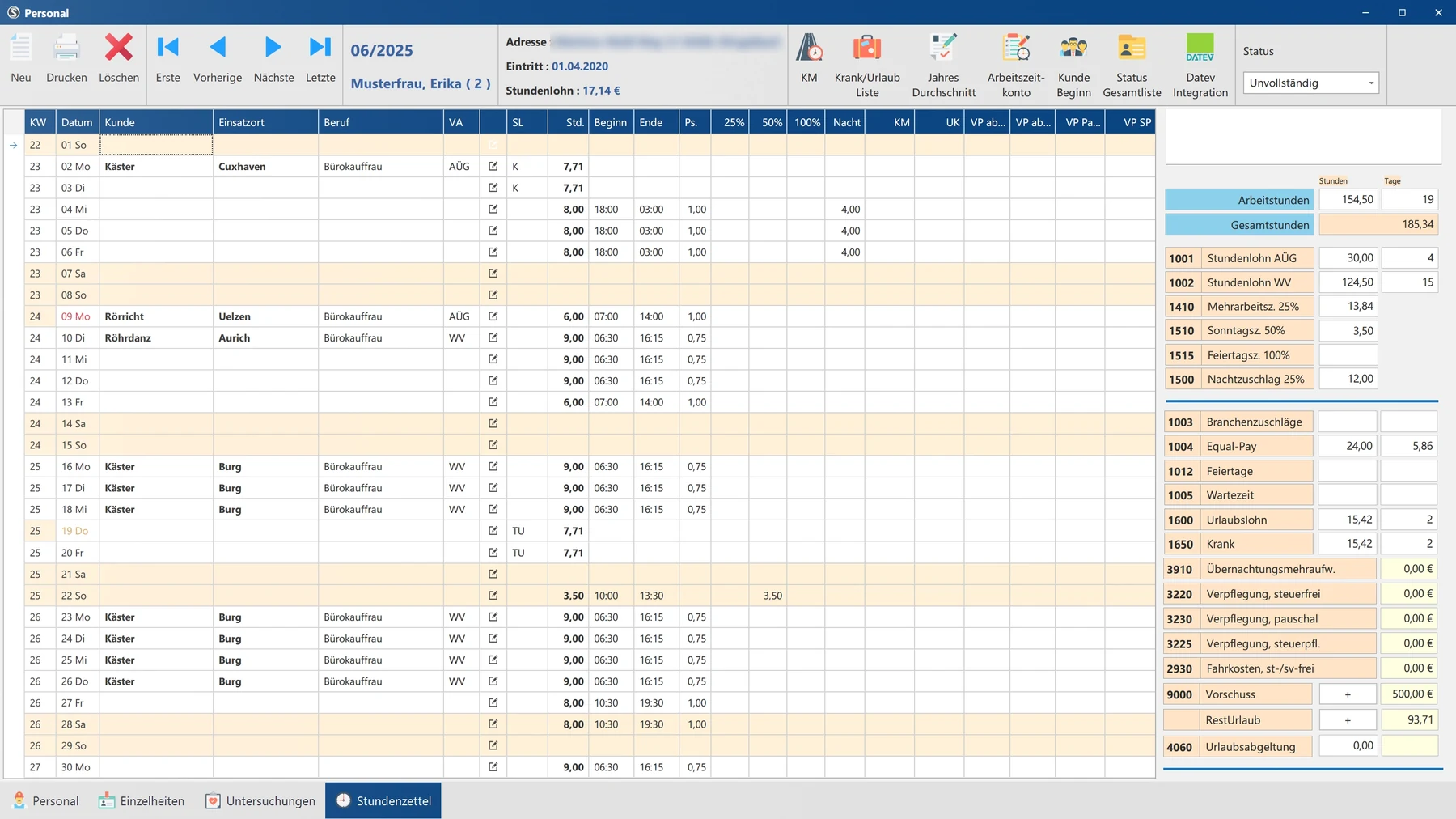
- During the assignment: recording of working hours, support from the scheduling team (Disposition), monitoring of the deadlines for industry supplements, Equal Pay and the maximum assignment period.
- Month end: the employee's wages and the client's invoice are produced from the same hours.
How does a temporary work agency make money?
The client pays a charge rate (Verrechnungssatz) for every hour worked, plus agreed supplements, for example for night, Sunday and public holiday work. From this, the temporary work agency must cover considerably more than the hourly wage: employer social security contributions, holidays, continued pay during sickness, public holidays, wages during periods without assignment, administration, scheduling and sales. If collectively agreed wages rise or industry supplements and Equal Pay take effect, the charge rate must be adjusted accordingly.
If the client takes on an employee, the temporary work agency may charge a reasonable placement fee (Vermittlungsvergütung). A ban on employing the worker later, on the other hand, would be invalid (§ 9(1) nos. 3 and 4 AÜG).
Which permit does a temporary work agency need?
- Permit requirement: Anyone who assigns employees in the course of their economic activity needs a permit from the Federal Employment Agency (§ 1(1) AÜG). The application can also be submitted via the Federal Employment Agency's online portal; fees are charged for processing.
- Time limit: The permit is initially valid for one year. The renewal application must be submitted at least three months before expiry; unless renewal is refused in good time, the permit is extended by one year (§ 2(4) AÜG).
- Unlimited: After three consecutive years of permitted activity, the permit can be granted without a time limit. It expires if it is not used for three years (§ 2(5) AÜG).
- Refusal: The permit is refused if the applicant is unreliable – for example because they do not comply with social security, tax or occupational health and safety law – if their business organisation does not ensure that employer obligations are met, or if they do not grant Equal Pay or the collectively agreed conditions (§ 3(1) AÜG).
- Ongoing obligations: The relocation, closure and opening of establishments and new managing directors must be reported; business records must be kept for three years (§ 7 AÜG).
What obligations does a temporary work agency have?
| Obligation | Legal basis |
|---|---|
| Written statement of the contract terms, including details of the permit and of payments during periods without assignment | § 11(1) AÜG, Nachweisgesetz (Act on the written statement of employment terms) |
| Information leaflet from the permit authority when the contract is concluded, in the native language on request | § 11(2) AÜG |
| Before each assignment: information that the employee is working as a temporary agency worker, name and address of the user undertaking in text form | § 11(2) sentence 4 AÜG |
| Collectively agreed conditions or Equal Pay and Equal Treatment | § 8 AÜG |
| Wage floor, also during periods without assignment | § 8(5), § 3a AÜG |
| Maximum assignment period of 18 months at the same user undertaking | § 1(1b) AÜG |
| Assignment contract in text form with a declaration on the permit; designation and specification before the assignment | § 12(1), § 1(1) AÜG |
| Inform clients and employees immediately if the permit lapses | § 11(3), § 12(2) AÜG |
| Wages when there is no assignment (default of acceptance, Annahmeverzug) – cannot be excluded by contract | § 11(4) AÜG |
In addition, there are the usual employer obligations: registration for social security, wage tax, working time recording and occupational health and safety – the latter together with the client (§ 11(6) AÜG).
Temporary work agency, recruitment agency, contract-for-work company
| Temporary work agency | Recruitment agency | Contract-for-work company | |
|---|---|---|---|
| Employer | temporary work agency | the client (after the placement) | contractor |
| Instructions | from the client | from the client as the new employer | from the contractor |
| Remuneration | charge rate per hour | one-off commission | price for the work |
| AÜG permit | required | not required | not required |
Anyone who assigns employees without assuming the usual employer obligations or the employer's risk is presumed to be engaged in job placement (Arbeitsvermittlung, § 1(2) AÜG). If a contract for work (Werkvertrag) is in reality performed as an assignment, the consequences of covert temporary agency work (verdeckte Arbeitnehmerüberlassung) apply.
Common mistakes
- The renewal application for the permit is submitted too late.
- Employees start at the client before the contract, specification and information are in place.
- No wages, or too little, are paid during periods without assignment.
- Deadlines for industry supplements, Equal Pay and the maximum assignment period are kept in Excel lists and overlooked.
- Hours are typed in several times for wages and invoices, and in the end the wages and invoices do not match.
- Assignments to construction businesses are not checked against the restrictions of § 1b AÜG.
Software for the daily work of a temporary work agency
The more employees are on assignment with more clients, the more depends on clean data: who works where, since when, under which collective agreement and with which supplements. Our SBM staffing software shows how scheduling, time recording, payroll preparation and invoicing come together in one system.
- § 1 AÜG – Temporary agency work, permit requirement
- § 2 AÜG – Granting and expiry of the permit
- § 3 AÜG – Refusal
- § 7 AÜG – Notifications and information
- § 9 AÜG – Invalidity
- § 11 AÜG – Other provisions on the temporary employment relationship
- § 12 AÜG – Legal relations between temporary work agency and user undertaking
- Federal Employment Agency: Technical Instructions on the AÜG (valid from 01.07.2026)
Note: This article does not replace legal advice. Last updated: 29.10.2026.