Türkçe
 Polski
 English
 Български
 Română
 Українська
 Magyar
 Deutsch

You calculate holiday entitlement in Germany with a simple formula: working days per week × 24 ÷ 6. The result is the statutory minimum leave – 20 days for a 5-day week, 24 for a 6-day week. Anyone who joins or leaves during the year receives, in certain cases, one twelfth for each full month. Employment contracts and collective agreements may provide for more leave.
This article is for HR departments, payroll offices and business owners – especially in temporary staffing companies – and for employees who want to check their own entitlement. It shows step by step how to calculate holiday entitlement: for full time, part time and Minijob, on joining, termination and leaving, with remaining leave and expiry.
Calculating holiday entitlement: the formula
Every employee is entitled to paid annual leave in every calendar year (§ 1 of the Federal Leave Act, Bundesurlaubsgesetz – BUrlG). Employees within the meaning of the Act are blue-collar workers, salaried staff and trainees (§ 2 BUrlG).
The statutory leave entitlement is at least 24 Werktage per year (§ 3 Abs. 1 BUrlG). Werktage are all calendar days except Sundays and public holidays (§ 3 Abs. 2 BUrlG). The Act therefore assumes a 6-day week from Monday to Saturday: 24 Werktage are four weeks of leave.
Anyone who works fewer than six days per week converts the 24 Werktage into their own working days (Arbeitstage). The Federal Ministry of Labour and Social Affairs (BMAS) gives this formula:
“Contractually agreed working days per week x 24 days […] : 6 working days (Monday to Saturday)”
Leave calculation for the 5-day week and the 6-day week
This is how holiday entitlement is calculated for any number of working days per week. The table shows the calculation for the statutory minimum leave and, next to it, the days of leave if full-time staff in the company have 30 days in a 5-day week.
| Working days per week | Calculation | Statutory minimum leave | With 30 days for full time |
|---|---|---|---|
| 6 | 6 × 24 ÷ 6 | 24 days of leave | 36 days of leave |
| 5 | 5 × 24 ÷ 6 | 20 days of leave | 30 days of leave |
| 4 | 4 × 24 ÷ 6 | 16 days of leave | 24 days of leave |
| 3 | 3 × 24 ÷ 6 | 12 days of leave | 18 days of leave |
| 2 | 2 × 24 ÷ 6 | 8 days of leave | 12 days of leave |
| 1 | 1 × 24 ÷ 6 | 4 days of leave | 6 days of leave |
The result is always the same number of weeks off: four with the statutory minimum leave, six in the comparison case. The 20 days of the 5-day week are the same minimum leave entitlement as 24 Werktage in the 6-day week.
If your employment contract or a collective agreement provides for more leave, calculate with that higher entitlement. BMAS gives an example: if full-time staff have 30 working days of leave in a 5-day week, an employee with three working days per week receives 18 days (30 ÷ 5 × 3).
Calculating leave for part-time work: working days are what counts
Part-time employees have a leave entitlement under the same conditions as full-time employees. According to BMAS, the minimum leave depends on the number of agreed working days per week, not on the hours. An employee who works part time for four hours on each of five days therefore has the same minimum entitlement of 20 days as a full-time employee.
Part-time employees who only work on certain days receive fewer days of leave, but also need fewer for a week off. In this way all employees receive leave of equivalent length (BAG, judgment of 19.03.2019 – 9 AZR 315/17).
If the number of working days changes from week to week, BMAS says the entitlement has to be converted to the working-time model in question. The next section shows how this is calculated.
Example: part time on three days per weekAn employee works on Mondays, Wednesdays and Fridays.
Statutory minimum leave: 3 × 24 ÷ 6 = 12 working days
With a contractual 30 days for full-time staff (5-day week): 30 ÷ 5 × 3 = 18 working days
In both cases she is off for as many weeks as a full-time employee: four and six respectively.
Calculating holiday entitlement for a Minijob and irregular working days
Marginal employment (geringfügige Beschäftigung, Minijob) also carries an entitlement to paid annual leave. The Minijob-Zentrale, the central office for Minijobs, calculates the leave entitlement with the same formula: number of working days per week × 24 ÷ 6. A Minijob on two days per week gives eight days of leave per year.
If a company gives its full-time staff more leave than the law requires, it must, according to the Minijob-Zentrale, also give more days of leave in a Minijob. The Minijob-Zentrale offers a leave calculator (Urlaubsrechner) on its website.
Irregular working days: If the number of working days differs from week to week, calculate with the working days of the whole year. For the statutory minimum leave, the Federal Labour Court gives the formula: 24 Werktage × days with a duty to work ÷ 312 Werktage (BAG, judgment of 30.11.2021 – 9 AZR 225/21).
The Minijob-Zentrale calculates with days of leave per year × individual working days per year ÷ 260 if the company has a 5-day week, and ÷ 312 for a 6-day week. Both routes lead to the same result.
Example: temporary help with changing working daysA temporary help in a Minijob works sometimes on one, sometimes on three days per week – on 104 days in the year. The company has a 5-day week.
Formula of the Minijob-Zentrale: 20 × 104 ÷ 260 = 8 days of leave
Formula of the Federal Labour Court: 24 × 104 ÷ 312 = 8 days of leave
Calculating pro rata leave when joining or leaving during the year
The full leave entitlement is acquired for the first time once the employment relationship has existed for six months (waiting period, Wartezeit – § 4 BUrlG). The waiting period begins with the employment relationship and only has to be completed once. The Act does not refer to an agreed probationary period here.
In three cases partial leave (Teilurlaub) under § 5 BUrlG arises instead. The employee is then entitled to one twelfth of the annual leave for each full month in which the employment relationship exists.
The formula: annual leave ÷ 12 × full months. Only full months between the joining date and the leaving date count for the calculation.
Rounding: If the calculation results in fractions of at least half a day, they are rounded up to full days of leave (§ 5 Abs. 2 BUrlG). According to the Federal Labour Court, smaller fractions are rounded neither up nor down, as long as there are no differing rules in statute, collective agreement or employment contract. The fraction remains (BAG, judgment of 23.01.2018 – 9 AZR 200/17).
Carry-over: At the employee's request, partial leave from the year of joining is carried over to the next calendar year (§ 7 Abs. 3 Satz 4 BUrlG).
Change of employer: Leave already granted by a previous employer in the current calendar year is credited (§ 6 Abs. 1 BUrlG). The previous employer must issue a certificate about this when the employee leaves (§ 6 Abs. 2 BUrlG).
Example: joining on 1 AugustA full-time employee, 5-day week, statutory minimum leave of 20 days. Until the end of the year the employment relationship exists for five full months.
20 ÷ 12 × 5 = 8.33 days of leave. The fraction is below half a day. So there is no rounding up, but no rounding down either: it stays at 8.33 days.
Example: leaving on 30 AprilSame starting position, the waiting period has been completed. In the year of leaving the employment relationship exists for four full months.
20 ÷ 12 × 4 = 6.67 days of leave, rounded up to 7 days of leave. Leave that can no longer be taken because the employment relationship ends must be paid out (§ 7 Abs. 4 BUrlG).
Holiday entitlement calculator: work it out yourself in three steps
There is no leave calculator to fill in on this page. But calculating holiday entitlement always follows the same three steps. You can also use them to check the result of a leave calculator.
For the calculation you need these details for each employee: the number of working days per week, the days of leave for full time under the employment contract or collective agreement, the joining date and – if there is one – the leaving date.
Determine the annual leave: The statutory leave entitlement is working days per week × 24 ÷ 6; the values for 1 to 6 days are in the table above. For additional contractual leave, calculate: days of leave for full time ÷ working days for full time × your own working days.
Check for partial leave under § 5 BUrlG: Joining on or after 1 July, leaving before the waiting period has expired, or leaving by 30 June after completing the waiting period. Only in these three cases do you calculate annual leave ÷ 12 × full months. Otherwise the full statutory minimum entitlement remains.
Round and deduct: Round fractions of 0.5 or more up to a full day; smaller ones stay as they are. Then deduct the days of leave already taken and the leave at the previous employer. The result is the remaining leave.
With these details, three typical cases are calculated like this:
| Case | Details | Calculation | Statutory leave entitlement |
|---|---|---|---|
| Joining on 1 September, full time | 5 working days, 4 full months | 20 ÷ 12 × 4 = 6.67 | 7 days (rounded up) |
| Leaving on 31 March after completing the waiting period, part time | 2 working days, 3 full months | 8 ÷ 12 × 3 | 2 days |
| Leaving on 30 September after completing the waiting period, full time | 5 working days per week | no partial leave, 5 × 24 ÷ 6 | 20 days |
Other rules may apply to additional leave under a contract or collective agreement, for example one twelfth per month for every joining or leaving.
Granting leave: wishes, continuous leave and illness
Once the holiday entitlement has been calculated, the question is when. When the dates are fixed, the employee's leave wishes have to be taken into account. A wish only has to give way if urgent operational reasons stand in the way or if the leave wishes of other employees take priority on social grounds (§ 7 Abs. 1 BUrlG).
Continuous leave: Leave has to be granted in one block. It may only be split for urgent operational or personal reasons. If there is an entitlement to more than twelve Werktage, one part of the leave must then cover at least twelve consecutive Werktage (§ 7 Abs. 2 BUrlG). In a 6-day week that is two weeks.
Illness during leave: If an employee falls ill during leave, the days of incapacity for work are not counted against the annual leave. The condition is a medical certificate (§ 9 BUrlG).
Leave pay (Urlaubsentgelt): Pay continues during leave. Leave pay is based on the average earnings of the last thirteen weeks before the leave begins (§ 11 Abs. 1 BUrlG). The GVP framework collective agreement instead uses the last three months for which payroll has been run (§ 10 MTV).
Remaining leave: carry-over, expiry and payment
Leave must be granted and taken in the current calendar year. Remaining leave may only be carried over to the next year if urgent operational or personal reasons justify this. It then has to be taken in the first three months of the following year, i.e. by 31 March (§ 7 Abs. 3 BUrlG).
The employer's duty to give notice (Hinweisobliegenheit): According to the Federal Labour Court, the leave entitlement generally only lapses if the employer has specifically asked the employee beforehand to take the leave and has pointed out clearly and in good time that the leave will otherwise expire (BAG, judgment of 19.02.2019 – 9 AZR 541/15, following the Court of Justice of the EU – EuGH, 06.11.2018 – C-684/16).
Long illness and the 15-month period: If an employee was prevented from taking leave for health reasons continuously from the beginning of the leave year until 31 March of the year after next, the leave entitlement expires at the end of these 15 months – even without notice from the employer. Leave from 2025 then expires at the end of 31 March 2027.
If, however, the employee still worked in the leave year before the illness began, the 15-month period as a rule only applies if the employer put the employee in a position to take the leave in good time (BAG, judgment of 20.12.2022 – 9 AZR 245/19, following EuGH, 22.09.2022 – C-518/20 and C-727/20).
Payment: The Federal Leave Act provides for remaining leave to be paid out in only one case: the leave can no longer be granted because the employment relationship ends, for example after notice of termination. It then has to be paid out (§ 7 Abs. 4 BUrlG).
Where remaining leave from several years is at stake, legal advice on employment law is sensible.
Holiday entitlement in temporary agency work: what the GVP collective agreement says
The Federal Leave Act also applies in temporary agency work (Arbeitnehmerüberlassung). How much leave is due beyond that depends on the collective agreement agreed in the employment contract. The DGB/GVP framework collective agreement (Manteltarifvertrag, MTV) – part of the GVP collective agreement, in force since 1 January 2026 – grades the leave entitlement by the length of the employment relationship (§ 9.3 MTV):
in the first year: 25 working days
in the second and third year: 27 working days
from the fourth year: 30 working days
The figures refer to a 5-day week. With more or fewer working days per week, leave increases or decreases accordingly (§ 9.4 MTV). When joining or leaving during the year, there is one twelfth for each full month, but at least the statutory minimum leave (§ 9.5 MTV).
Client assignments that have already been fixed have to be taken into account when planning leave. Days of leave that have been approved for employees are not available for client assignments (§ 9.2 MTV).
Further rules of the MTV for the calculation:
Leaving within the first six months: The leave entitlement is then governed by the Federal Leave Act (§ 9.3 MTV).
Public holiday during leave: Whether a public holiday counts as a day of leave depends on the public-holiday law at the employer's registered office. If a client assignment is interrupted for the leave, the public-holiday law of the place of assignment applies (§ 9.4 MTV).
Remaining leave: The entitlement lapses at the end of the calendar year unless it was claimed beforehand without success or could not be taken for operational reasons or because of illness. In that case the remaining leave is carried over and has to be taken by 31 March of the following year. In the case of long-term incapacity for work it expires on 31 March of the year after next (§ 9.6 MTV).
Termination: If the employment relationship ends, the leave has to be granted and taken during the notice period. If that is not possible, it is paid out (§ 9.7 MTV).
Collective agreements may deviate from most provisions of the Federal Leave Act, but not from the minimum leave of 24 Werktage (§ 13 Abs. 1 BUrlG). Other collective agreements have their own rules. If no collective agreement is applied, the principle of equal treatment applies (§ 8 Abs. 1 AÜG): the Federal Employment Agency (Bundesagentur für Arbeit) counts leave among the essential working conditions.
In any case it makes sense to inform every employee once a year about remaining leave and deadlines and to document that notice.
Example: joining on 1 April, GVP agreement, 5-day weekIn the first year annual leave is 25 working days. Until the end of the year there are nine full months: 25 ÷ 12 × 9 = 18.75 days.
However, because the waiting period is completed at the end of 30 September, the full statutory leave entitlement of 20 days already exists for this year. Under the wording of § 9.5 MTV, 20 days are therefore the lower limit.
Four typical mistakes when calculating leave
These are the four points where calculations easily go wrong:
Werktage confused with working days
24 Werktage refer to a 6-day week. With five working days per week, that is 20 days of leave.
Part time calculated by hours
For minimum leave, the working days per week count, not the weekly hours.
Joining on 1 July treated as a full year
The waiting period is not completed in the year of joining. Partial leave arises: six twelfths of the annual leave.
Leave at the previous employer overlooked
Leave already granted in the same calendar year is credited. That is what the leave certificate under § 6 Abs. 2 BUrlG is for.
Keeping track of leave entitlements for many employees
Joining dates, part-time models and collective-agreement grades differ from employee to employee.
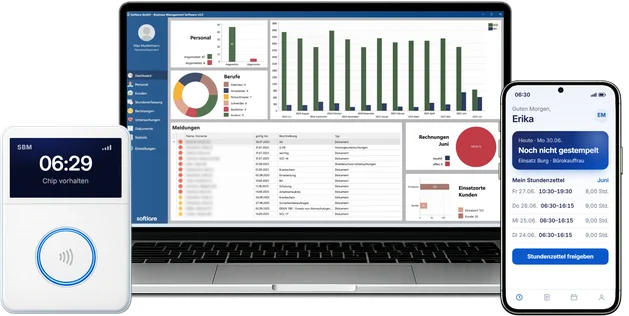
In the temporary staffing software SBM you store the leave entitlement per employee – by length of service, for the probationary period or individually – and see remaining leave and leave planning. Days of leave appear with their own code in the timesheet. The check before month-end closing reports, among other things, hours that were recorded on days of leave.
Payroll itself does not run in SBM: SBM prepares the payroll data and transfers it to DATEV or Addison.
Frequently asked questions about holiday entitlement
24 Werktage per year (§ 3 Abs. 1 BUrlG). The Federal Leave Act assumes a 6-day week. For a 5-day week the statutory leave entitlement is 20 days, i.e. four weeks.
Number of working days per week × 24 ÷ 6 gives the statutory minimum leave, so 12 days of leave with three working days. Convert additional contractual leave in the same ratio: days of leave for full time ÷ working days for full time × your own working days.
For the year of joining, six twelfths of the annual leave – with statutory minimum leave in a 5-day week, that is 10 days. The full entitlement no longer arises in that year (BAG, judgment of 17.11.2015 – 9 AZR 179/15).
Fractions of at least half a day are rounded up to full days of leave (§ 5 Abs. 2 BUrlG). Smaller fractions stay as they are unless other rules apply (BAG, 9 AZR 200/17).
After notice of termination, remaining leave is taken as far as this is possible before the leaving date. Leave that can no longer be granted because the employment relationship ends must be compensated, i.e. paid out (§ 7 Abs. 4 BUrlG).
No. Leave that has been carried over does have to be taken by 31 March (§ 7 Abs. 3 BUrlG). But as a rule it only lapses if the employer has asked the employee beforehand to take the leave and has pointed out that it will expire (BAG, 9 AZR 541/15). In the case of long illness, a period of 15 months after the end of the leave year applies (BAG, 9 AZR 245/19).
Severely disabled people receive five additional working days in the leave year, based on a 5-day week (§ 208 SGB IX). For young people, at least 25 to 30 Werktage apply depending on age (§ 19 JArbSchG).
Calculating leave means knowing working days, months and the collective agreement.
The formula you use to calculate holiday entitlement is short. Mistakes happen in the details: part-time models, joining and leaving during the year, rounding, remaining leave and collective-agreement grades. Those who keep this data up to date for each employee calculate faster and need fewer corrections.
See payroll preparation with SBMAs of: November 2026. This article provides a general overview and does not replace legal advice. Sources: §§ 1–9, 11, 13 BUrlG; § 8 AÜG; § 208 SGB IX; § 19 JArbSchG; BMAS, “Teilzeit – Alles was Recht ist” (July 2025) and questions and answers on bridge part-time work (Brückenteilzeit); BAG, 9 AZR 179/15, 9 AZR 200/17, 9 AZR 541/15, 9 AZR 315/17, 9 AZR 225/21 and 9 AZR 245/19; Minijob-Zentrale, “Urlaubsanspruch im Minijob” and magazine article “Urlaub im Minijob” (22.07.2026); DGB/GVP framework collective agreement of 20.05.2025; AÜG instructions (Fachliche Weisungen) of the Federal Employment Agency (valid from 01.07.2026).