Türkçe
 Magyar
 Български
 Română
 Deutsch
 Українська
 Polski
 English

You calculate the hourly charge rate (Stundenverrechnungssatz) with one formula: annual costs ÷ productive hours per year, plus profit and risk. The result is a net hourly rate; VAT (Umsatzsteuer) is added on top.
This article works through two examples step by step. A skilled-trade business (Handwerksbetrieb) with three skilled workers arrives at €65.65 net per productive working hour. A staffing provider turns an hourly wage of €17.11 into €31.99 net per assignment hour, a factor of 1.87.
All example values are assumptions, not market data. At the end you will find typical mistakes and what they cost in the example.
What is the hourly charge rate? The difference from the hourly wage
The hourly charge rate, or hourly rate for short, is the amount a client pays for one working hour performed. The rate covers all the costs of the business and includes the profit.
The hourly wage is only one part of it: the gross wage the employee receives per hour. The Dortmund Chamber of Skilled Crafts (Handwerkskammer Dortmund) calls the hourly charge rate the most important calculation figure in the skilled trades and warns against confusing it with hourly earnings.
Official statistics show how large the difference is even before overheads and profit. In industry and the service sector, one working hour performed cost an average of €45.00 in 2025 (Federal Statistical Office, Statistisches Bundesamt, annual estimate).
These labour costs contain only gross earnings and non-wage labour costs. Rent, vehicles, administration and profit are still missing.
Calculating the hourly charge rate: formula and five components
The formula is the same for every trade and every sector, for the painter as for the freelance developer or the staffing provider:
Hourly charge rate = (personnel costs + overheads + owner’s salary) ÷ productive hours per year × (1 + mark-up for profit and risk)
The calculation is on a full-cost basis: everything the company costs in a year has to come back in through the hours charged. The Konstanz Chamber of Skilled Crafts (Handwerkskammer Konstanz) advises taking the total costs from the management accounts (betriebswirtschaftliche Auswertung) or the annual financial statements and using twelve months as the basis.
The formula has five components:
Hourly charge rate calculation: employer contributions 2026
The non-wage labour costs come on top of the gross wage. Employers and employees each bear half of the contributions to pension, health, long-term care and unemployment insurance.
These rates apply for 2026:
| Item | Contribution rate | Employer share |
|---|---|---|
| Pension insurance | 18.6% | 9.3% |
| Health insurance, general contribution rate | 14.6% | 7.3% |
| Health insurance, average additional contribution 2026 | 2.9% | 1.45% |
| Long-term care insurance | 3.6% | 1.8% |
| Unemployment insurance | 2.6% | 1.3% |
| Total social security | 21.15% | |
| Insolvency benefit levy (Insolvenzgeldumlage, employer only) | 0.15% | 0.15% |
The additional contribution (Zusatzbeitrag) depends on the employee’s health insurance fund (Krankenkasse). 2.9% is the official average.
In Saxony, the employer bears 1.3% of the 3.6% for long-term care insurance. The surcharge for childless persons is paid by employees alone.
On top of this come the U1 and U2 levies (Umlagen) and the contribution to the employers’ liability insurance association (Berufsgenossenschaft). Their amount depends on the health insurance fund, the hazard tariff (Gefahrtarif) and the activity. The examples in this article assume a combined 3.5% for them – an assumption, not an official figure.
Together this gives 24.8% non-wage labour costs on the gross wage: 21.15% plus 0.15% plus 3.5%. Both examples use this rate.
Productive hours per year: from 365 days to the annual hours
A typical mistake lies in the divisor. If you divide the annual costs by 2,080 hours (52 weeks × 40-hour week), you set the hourly rate too low and lose money with every hour. The reason: these hours are paid, but not all of them are charged.
In their calculation schemes for trade businesses, the Chambers of Skilled Crafts therefore start from the calendar days and deduct step by step what no client pays for: weekends, holiday, public holidays, sickness and unproductive time.
| Step | Calculation | Result |
|---|---|---|
| Calendar days 2026 | – | 365 days |
| Saturdays and Sundays | − 104 days | 261 days |
| Public holidays on weekdays (assumption) | − 11 days | 250 working days |
| Holiday (assumption) | − 30 days | 220 days |
| Sickness (assumption) | − 15 days | 205 attendance days |
| Working time per day | × 8 hours | 1,640 attendance hours |
| Unproductive time (assumption: 20%) | − 328 hours | 1,312 productive hours |
Where the figures come from:
Working days: The Federal Statistical Office gives an average of 250.5 working days nationwide for 2026. The number of public holidays differs from federal state to federal state.
Holiday: The law requires at least 24 working days (Werktage) a year (§ 3 BUrlG); a collective agreement or employment contract can provide for more.
Sickness: In 2025, employees were on sick leave for an average of 14.6 working days (Federal Statistical Office). The example rounds up to 15.
Unproductive time: According to an article by the Konstanz Chamber of Skilled Crafts, travel to the job site and preparation do not count as productive hours. The share differs in every business. It can be measured with time recording per order.
Of 2,080 paid annual hours, 1,312 productive hours remain in the example, i.e. 63%. The share of productive hours in attendance hours is called utilisation or productivity; here it is 80%.
The smaller the number of hours over which the costs are spread, the higher the rate. In the assessment of the Konstanz Chamber of Skilled Crafts, increasing the productive hours is more effective than cutting costs.
Worked example: hourly rate in the skilled trades, step by step
The sample calculation: a trade business with an owner and three skilled workers (Gesellen) on a 40-hour week. The owner does 600 productive hours a year; the rest of his working time goes into quotations, planning and office work.
The non-wage labour costs of 24.8% and the 1,312 productive annual hours per skilled worker come from the two sections above. All other figures are assumptions.
| Step | Item | Calculation | Amount |
|---|---|---|---|
| 1 | Gross wage of the skilled workers | 3 × 2,080 hrs × €20.00 | €124,800.00 |
| 2 | Non-wage labour costs (24.8%) | €124,800.00 × 24.8% | €30,950.40 |
| 3 | Overheads per year | Rent, vehicles, insurance, office, depreciation, interest | €60,000.00 |
| 4 | Owner’s salary (Unternehmerlohn) | imputed, including pension provision | €60,000.00 |
| 5 | Annual costs | Steps 1 to 4 | €275,750.40 |
| 6 | Productive hours | 3 × 1,312 + 600 | 4,536 hrs |
| 7 | Full cost per hour | €275,750.40 ÷ 4,536 | €60.79 |
| 8 | Profit and risk (8%) | €60.79 × 8% | €4.86 |
| 9 | Net hourly charge rate | Step 7 + step 8 | €65.65 |
The business has to charge €65.65 net per working hour, although the skilled worker receives a gross wage of €20.00. The profit mark-up from step 8 gives a profit share of €4.86 per hour – but only if all 4,536 hours are sold.
Materials are not included; they are calculated separately, for example through a materials mark-up. Depending on the trade, further items are added, for example contributions to pension and welfare funds (Versorgungskassen).
How strongly utilisation affects the rate: If the productive share falls from 80% to 70%, 1,148 hours remain per skilled worker. The same costs are then spread over 4,044 hours, and the hourly rate rises to €73.65.
Time recording shows whether the assumption is right: productive hours divided by attendance hours.
Self-employed people without employees calculate their hourly rate with the same formula. The owner’s salary, including their own pension provision, takes the place of the personnel costs. The divisor is the hours that clients actually pay for.
Assumptions, not benchmarksWage, overheads, owner’s salary, utilisation and mark-up have been chosen for the worked example and are not a customary market hourly rate. Use your own figures. Trade businesses are supported in this by the business advisory services of the Chambers of Skilled Crafts.
Net or gross: VAT on the hourly rate
The calculation is net. The net hourly rate stays in the business; VAT is added on the invoice and goes to the tax office.
Tax rate: VAT is 19% of the taxable amount (§ 12 Abs. 1 UStG). The taxable amount is the consideration excluding VAT (§ 10 Abs. 1 UStG).
Gross hourly rate: In the sample calculation, €65.65 net plus €12.47 VAT becomes €78.12 gross.
Private customers: Anyone who offers services to consumers or advertises with prices must state the total price including VAT (§ 3 Abs. 1 and § 2 Nr. 3 PAngV). Tradespeople therefore quote private customers the gross hourly rate.
Business customers: Businesses can deduct the VAT invoiced as input tax under the conditions of § 15 UStG. For them, the net hourly charge rate is what counts.
Small businesses (Kleinunternehmer): Their sales are tax-exempt if total turnover did not exceed €25,000 in the previous year and does not exceed €100,000 in the current year (§ 19 Abs. 1 UStG). Net and gross are then the same.
In temporary agency work, the clients are almost always businesses. That is why the net hourly charge rate is what is negotiated and compared.
Special case of agency work: assignment hours instead of productive hours
The same formula applies to staffing providers. Here, every hour the employee works on assignment at the client is productive. Utilisation is decided by an item that trade businesses do not know in this form: the time without an assignment between two orders.
The client pays only for assignment hours actually worked. The staffing provider pays for more:
Holiday: The DGB/GVP framework collective agreement (Manteltarifvertrag) grants 25 working days (Arbeitstage) in the first year, 27 in the second and third, and 30 from the fourth year (§ 9.3).
Public holidays: If working time is lost because of a statutory public holiday, pay continues (§ 2 Abs. 1 EFZG).
Sickness: continued pay (Entgeltfortzahlung) for up to six weeks (§ 3 Abs. 1 EFZG). The entitlement arises after four weeks of uninterrupted employment. Employers with, as a rule, no more than 30 employees are reimbursed 80% by law through the U1 procedure; the statutes of the health insurance fund can reduce the rate to as low as 40% (§§ 1, 9 AAG).
Time without an assignment: In a temporary agency employment relationship, the entitlement to pay in the event of default of acceptance (Annahmeverzug) cannot be excluded or limited by contract (§ 11 Abs. 4 Satz 2 AÜG). So the wage continues even without an assignment. A working time account (Arbeitszeitkonto) can even out fluctuations (§ 4 of the DGB/GVP framework collective agreement).
This gives the share of billable hours. The example uses 1,820 paid hours a year (151.67 hours × 12 months, § 3.1 of the framework collective agreement).
From this, 25 days of holiday, 9 public holidays, 12 sick days and 8 days without an assignment at 7 hours each are deducted, 378 hours in total. That leaves 1,442 billable hours, or 79.2%.
The scheme follows the collectively agreed 35-hour week with its own assumptions; that is why the days differ from the trade example.
Calculating the hourly charge rate in agency work: scheme with example values
Example: an employee in pay group 3 of the DGB/GVP set of collective agreements, hourly pay €17.11 (valid 01.09.2026 to 31.03.2027), without an industry supplement.
| Line | Item | Calculation | Amount |
|---|---|---|---|
| 1 | Hourly wage | Collectively agreed pay EG 3 | €17.11 |
| 2 | Paid hours per year | 151.67 × 12 | 1,820 hrs |
| 3 | Annual wage | 1,820 × €17.11 | €31,140.20 |
| 4 | Non-wage labour costs (assumption: 24.8%) | €31,140.20 × 24.8% | €7,722.77 |
| 5 | Personnel costs per year | Line 3 + line 4 | €38,862.97 |
| 6 | Billable hours (assumption) | 1,820 − 378 | 1,442 hrs |
| 7 | Personnel costs per billable hour | €38,862.97 ÷ 1,442 | €26.95 |
| 8 | Overheads (assumption: 12%) | €26.95 × 12% | €3.23 |
| 9 | Full cost | Line 7 + line 8 | €30.18 |
| 10 | Profit (assumption: 6%) | €30.18 × 6% | €1.81 |
| 11 | Hourly charge rate, net | Line 9 + line 10 | €31.99 |
| 12 | Factor | €31.99 ÷ €17.11 | 1.87 |
The 24.8% in line 4 is the non-wage labour costs from the section above. In the example, the overheads of 12% contain internal staff, management, rent, software, recruiting and occupational safety.
Example values, not market dataDays not worked, non-wage labour costs beyond the statutory rates, overheads and profit are assumptions. Use your own figures. Not included are holiday pay and Christmas bonus, supplements for night, Sunday and public holiday work, and travel and accommodation costs.
Calculating the hourly charge rate in Excel: build it yourself for free
You can build an hourly rate calculator yourself in Excel. For the agency-work scheme, the calculator needs one worksheet with six inputs and one formula:
B1: hourly wage
B2: non-wage labour costs in per cent
B3: paid hours per year
B4: non-billable hours per year
B5: overheads in per cent
B6: profit in per cent
B7 then contains: =B1*(1+B2)/((B3-B4)/B3)*(1+B5)*(1+B6)
With the example values, the formula gives €32.00. The scheme above rounds in every line and therefore arrives at €31.99.
For the trade example, =(C1+C2+C3)/C4*(1+C5) is enough, with personnel costs, overheads, owner’s salary, productive hours and mark-up in C1 to C5.
Create one row per client and qualification. Your calculator then shows at once what effect a different wage or a different sickness rate has on the hourly rate.
Short formula for agency workCharge rate = hourly wage × (1 + non-wage labour costs) ÷ share of billable hours × (1 + overheads) × (1 + profit)
Pricing in temporary agency work: what do industry supplements and Equal Pay change?
Both change line 1 of the scheme, and they do so after fixed periods.
Industry supplements: A collective agreement on industry supplements (Tarifvertrag über Branchenzuschläge) increases the collectively agreed pay in stages. The stages and percentages are set by the relevant collective agreement on industry supplements. Some agreements also provide for a cap (Deckelung): the supplement can be limited so that pay does not exceed a certain share of the pay of comparable employees at the client.
Equal Pay: Without a collective agreement on industry supplements, a collective agreement may deviate from the principle of equal treatment (Gleichstellungsgrundsatz) with regard to pay only in the first nine months of an assignment (§ 8 Abs. 4 Satz 1 AÜG). After that, the client’s comparable pay takes the place of the collectively agreed wage. Details can be found in the glossary under Equal Pay.
An assumed first stage of 15% shows what this means for the price: €17.11 plus 15% is €19.68. With the same assumptions, the charge rate rises from €31.99 to €36.80. The wage rises by €2.57, the price by €4.81. In the example, every additional euro of wage therefore costs €1.87 more in charge rate.
For the quotation, this means: stages and key dates belong in the price agreement, either as a charge rate per stage or as an adjustment clause.
Typical mistakes in the hourly rate – and what they cost
Each of these mistakes pushes the hourly rate below cost or reduces the margin, in the skilled trades as in agency work. If you calculate like this, you win orders and lose money.
Price by gut feeling: If you estimate the hourly rate or take it over from competitors, you do not reflect your own cost structure. The business advisory service of the Konstanz Chamber of Skilled Crafts warns against this.
Owner’s salary left out: Without the €60,000 owner’s salary, the rate in the trade example would be €51.36 instead of €65.65.
Net and gross confused: If you quote €65.65 as a gross price, you pay €10.48 of it in VAT. That leaves €55.17 – less than the full cost of €60.79.
Divided by 2,080 hours
If you divide the annual costs by all paid hours, holiday, public holidays, sickness and unproductive time remain uncovered. In the trade example, the result would be €43.53 instead of €65.65.
Utilisation overestimated
Travel and idle time between orders in the skilled trades, time without an assignment in agency work: wages are due even without an assignment (§ 11 Abs. 4 AÜG). The calculation needs a separate item for this.
Stages not priced in
Industry supplements and Equal Pay raise the wage on fixed dates. Without a price per stage, the margin shrinks.
Old rates carried forward
Collectively agreed pay, contribution rates and overheads change. With every change, the calculation has to be redone.
FAQ on the hourly charge rate
Divide the annual costs (personnel costs, overheads, owner’s salary) by the productive hours per year and add the mark-up for profit and risk. In the trade example: €275,750.40 ÷ 4,536 hours = €60.79, plus 8% = €65.65 net. The full-cost calculation applies to every sector.
The hourly wage is the employee’s gross wage. The hourly charge rate is the price of one working hour for the client. It also covers non-wage labour costs, paid non-working time, overheads, owner’s salary and profit. In the trade example, an hourly wage of €20.00 compares with an hourly rate of €65.65.
There is no fixed value; the number of hours depends on working time, holiday, sickness and utilisation in the business. With a 40-hour week, the worked example arrives at 1,312 productive hours per employee and year.
The calculation is net. 19% VAT is added to the rate (§ 12 Abs. 1 UStG). Consumers must be given the total price including VAT (§ 3 PAngV); between businesses, the net hourly rate is compared.
There is no fixed value. The factor is the result of non-wage labour costs, non-working time, overheads and profit. In the example it is 1.87 – a calculated value, not a market figure.
Not in the scheme. Supplements for night work, Sunday work, public holiday work and overtime arise only for certain hours. They can be agreed separately, for example as a percentage mark-up on the charge rate for the hours concerned.
An hourly charge rate is only as good as its assumptions. Costs, productive hours and utilisation change in every business. The calculation should therefore be reviewed regularly with current figures, at the latest with every change in collectively agreed pay or contributions. Otherwise the margin shrinks unnoticed.
In the SBM staffing software, you store charge rates per client with a validity date, and the hourly wage, charge rate and supplements per order. SBM applies industry supplement stages automatically and calculates the start of Equal Pay per employee and client.
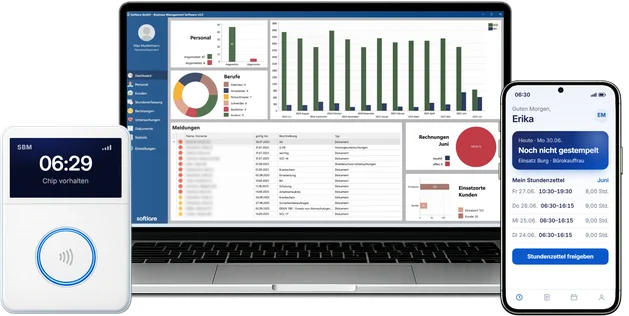
The hours worked go into the timesheet via time recording at the terminal or by hand; SBM creates the invoice from the timesheet. SBM does not produce the payroll itself; the prepared data goes to DATEV or Addison.
If you know the stages, you set the price before the assignment.
Industry supplements and Equal Pay arrive after fixed periods. With the dates per employee and client, the charge rate can be adjusted in good time.
Equal Pay & industry supplements in SBMAs of: November 2026. This article provides a general overview and does not replace legal or tax advice. Sources: Deutsche Rentenversicherung (German Pension Insurance), pension insurance figures (Werte der Rentenversicherung, as of 01.07.2026); Federal Ministry of Health (Bundesministerium für Gesundheit), announcement of the average additional contribution rate 2026 (BAnz AT 10.11.2025 B7) and information on long-term care insurance; §§ 341, 346, 358, 360 SGB III; § 168 SGB VI; §§ 241, 249 SGB V; § 58 SGB XI; §§ 1, 9 AAG; § 3 BUrlG; §§ 2, 3 EFZG; §§ 8, 11 AÜG; DGB/GVP framework collective agreement (Manteltarifvertrag) and pay collective agreement (Entgelttarifvertrag), as of January 2026; IG Metall, FAQ on temporary agency work and the collective agreements on industry supplements (as of November 2025); Federal Statistical Office (Statistisches Bundesamt), press release no. 148 of 29.04.2026 (labour costs 2025), Zahl der Woche no. 50 of 09.12.2025 (working days 2026) and the sickness absence indicator (Krankenstand, as of 23.07.2026); Handwerkskammer Dortmund, „Controlling im Wirtschaftsbereich Handwerk“ (3rd edition 2019); Handwerkskammer Konstanz, „Wie setzt sich eine Handwerkerstunde zusammen?“ (18.11.2025); §§ 10, 12, 15, 19 UStG; §§ 2, 3 PAngV.