Polski
 Українська
 Български
 English
 Magyar
 Deutsch
 Română
 Türkçe

Anyone who wants to calculate a night supplement (Nachtzuschlag) needs only three inputs: the number of night hours, the gross hourly wage and the supplement rate. A night supplement calculator (Nachtzuschlag-Rechner) asks for nothing more either.
The formula is night hours × hourly wage × supplement rate. With 7 night hours, €16.00 per hour and 25 per cent, that makes a night supplement of €28.00. Sunday and public holiday supplements (Sonntagszuschlag, Feiertagszuschlag) are calculated in the same way.
Harder than the formula is what has to be settled beforehand: which hours count as night, which rate applies and which part of the supplement remains tax-free. This article goes through the calculation of the night supplement case by case – first in general, then for scheduling teams and payroll offices in temporary agency work.
Night supplement calculator: the formula in three steps
Determine the number of hours subject to a supplement. Start of shift, end of shift and breaks are in the timesheet. Only the hours that fall within the time window of the rule count, for example from 23 to 6 o’clock.
Define the basis. This is the hourly wage to which the supplement relates. The law refers to the gross pay (Bruttoarbeitsentgelt) due for these hours. Collective agreements define the basis themselves.
Multiply by the supplement rate. The rate is set out in the collective agreement, the works agreement (Betriebsvereinbarung) or the employment contract.
The result is a gross amount that is paid in addition to the hourly wage for these hours.
This formula is inside every calculator for supplements. With it and the examples below, you can check any case by hand or in a spreadsheet.
FormulaSupplement = hours subject to a supplement × hourly wage × supplement rate
Calculating the night supplement: the inputs you need
Whether it is a night supplement calculator, a general supplement calculator or a spreadsheet: a calculator only multiplies what it is given. To calculate the night supplement, these inputs therefore have to be settled:
| Input | Source | Example |
|---|---|---|
| Start of shift and end of shift | Timesheet or time tracking | 22:00 to 06:00 |
| Breaks | Timesheet or time tracking | 30 minutes, unpaid |
| Time window of the night | Law, collective agreement or employment contract | 23 to 6 o’clock |
| Gross hourly wage | Employment contract or pay table | €16.00 |
| Supplement rate | Collective agreement, works agreement or employment contract | 25% |
| Date and federal state (Bundesland) of the place of work | Calendar and public holiday law | Sunday or public holiday |
For payroll, a second calculation is added: the tax-free share and the share exempt from contributions. A different time window applies to it than in employment law.
Calculating supplements: four examples
Assumptions for all examples: a gross hourly wage of €16.00, 8 working hours, breaks not taken into account.
The rates of 25%, 50% and 100% are the maximum rates of the DGB/GVP framework collective agreement (Manteltarifvertrag).
| Example | Hours subject to a supplement | Calculation | Supplement | Pay including supplement |
|---|---|---|---|---|
| Night shift on a working day, 22 to 6 o’clock | 7 night hours (23 to 6 o’clock) | 7 × €16.00 × 25% | €28.00 | €156.00 |
| Sunday, 6 to 14 o’clock | 8 Sunday hours | 8 × €16.00 × 50% | €64.00 | €192.00 |
| Public holiday, 6 to 14 o’clock | 8 public holiday hours | 8 × €16.00 × 100% | €128.00 | €256.00 |
| Night shift from Sunday 22 o’clock to Monday 6 o’clock | 2 Sunday hours, 6 night hours | 2 × €16.00 × 50% + 6 × €16.00 × 25% | €40.00 | €168.00 |
On the fourth example: from 23 to 24 o’clock, the Sunday supplement and the night supplement coincide. The DGB/GVP agreement then pays only the higher one, i.e. 50%.
From 0 o’clock it is Monday. The night supplement of 25 per cent remains.
Example values, not advice on collective agreementsAll amounts are worked examples. Which rate applies in an assignment depends on the collective agreement and on the supplement rules of the client establishment.
Example: night shift from 22:00 to 06:00
An employee works from 22:00 to 06:00. The gross hourly wage is €16.00, the night supplement 25 per cent for the night-time from 23 to 6 o’clock.
Count the night work hours. From 23:00 to 06:00 there are 7 hours. The hour from 22 to 23 o’clock lies before the time window.
Calculate the night supplement per hour. €16.00 × 25% = €4.00 per hour.
Multiply. 7 hours × €4.00 = €28.00 night supplement.
Result: for the shift, 8 × €16.00 = €128.00 in wages and a night supplement of €28.00 are due, together €156.00 gross.
With a break: Rest breaks do not count as working time (§ 2 Abs. 1 ArbZG). If there is an unpaid break of 30 minutes between 2:00 and 2:30, 6.5 night work hours remain. The night supplement is then 6.5 × €4.00 = €26.00.
With a different time window: If, under the rule in the establishment, the night already begins at 22 o’clock, all 8 hours count. The night supplement rises to 8 × €4.00 = €32.00.
How high is the night supplement by law?
The Working Hours Act (Arbeitszeitgesetz, ArbZG) does not state a percentage. For the hours worked during night-time, night workers receive paid days off or an appropriate supplement.
This applies only where no collective agreement governs the compensation.
In principle, the employer can choose whether to pay money, grant days off or combine the two (BAG, 10 AZR 423/14).
„Soweit keine tarifvertraglichen Ausgleichsregelungen bestehen, hat der Arbeitgeber dem Nachtarbeitnehmer für die während der Nachtzeit geleisteten Arbeitsstunden eine angemessene Zahl bezahlter freier Tage oder einen angemessenen Zuschlag auf das ihm hierfür zustehende Bruttoarbeitsentgelt zu gewähren.“ [Where no compensation rules under a collective agreement exist, the employer must grant the night worker, for the hours worked during night-time, an appropriate number of paid days off or an appropriate supplement on the gross pay due to them for those hours.]
Night-time, night work, night worker: the terms in employment law
The terms are defined in § 2 Abs. 3 to 5 ArbZG:
Night-time (Nachtzeit) is the time from 23 to 6 o’clock, in bakeries and pastry shops from 22 to 5 o’clock.
Night work (Nachtarbeit) is any work that covers more than two hours of night-time.
A night worker (Nachtarbeitnehmer) is anyone who normally does night work in rotating shifts or works at night on at least 48 days in a calendar year.
The statutory entitlement under § 6 Abs. 5 ArbZG is due only to night workers, and only for the hours during night-time.
Whether a shift is night work depends on the threshold of ‘more than two hours’. Three shifts for comparison:
Collective agreements can tie the supplement to other conditions. The DGB/GVP framework collective agreement does not have the two-hour threshold: there, night work is work between 23.00 and 6.00.
Appropriate night supplement: the guideline values of the Federal Labour Court
The Federal Labour Court (Bundesarbeitsgericht, BAG) has specified what is appropriate (judgment of 09.12.2015 – 10 AZR 423/14). The amount of the night supplement depends on the strain:
| Case | BAG guideline value |
|---|---|
| Night workers without special circumstances | as a rule 25% on top of the gross hourly wage, or a corresponding number of paid days off |
| Permanent night work (Dauernachtarbeit) | as a rule 30% |
| Lower strain, for example a not insignificant amount of standby time at the workplace (Arbeitsbereitschaft) or on-call duty at night (Bereitschaftsdienst) | lower compensation may be sufficient |
| Night work that is strictly unavoidable because of the nature of the activity (named in the judgment: rescue service) | even then, as a rule at least 10% |
This is not a fixed value for every employment relationship.
According to the judgment, the economic situation of the employer does not justify a lower rate.
If the employer pays less than these guideline values, it must explain why a lower night supplement is supposed to be appropriate.
Worked example for permanent night work: 7 night hours × €16.00 hourly wage × 30% = €33.60 night supplement. That is €5.60 more than at 25 per cent.
How long may a night shift last?
The working time of night workers on working days must not exceed eight hours (§ 6 Abs. 2 ArbZG).
Up to ten hours are permitted only if an average of eight hours per working day is not exceeded within a calendar month or within four weeks.
Collective agreement rules can set a different averaging period (Ausgleichszeitraum) and place the start of the seven-hour night-time between 22 and 24 o’clock (§ 7 Abs. 1 Nr. 4 and 5 ArbZG).
For calculating the supplement, every hour worked during night-time counts, including in an extended shift. The night working time therefore belongs in the timesheet with its start and end.
Bakeries and pastry shops: night-time from 22 to 5 o’clock
In bakeries and pastry shops, night-time is one hour earlier: from 22 to 5 o’clock (§ 2 Abs. 3 ArbZG). The other rules remain the same.
Shift from 21:00 to 05:00: 7 hours fall within night-time. With an hourly wage of €16.00 and a supplement rate of 25 per cent, that makes a night supplement of €28.00.
Shift from 03:00 to 11:00: Only 2 hours fall within night-time, from 3 to 5 o’clock. That is not more than two hours and therefore not night work within the meaning of the Working Hours Act.
For tax, the industry makes no difference: § 3b EStG knows only the time window from 20 to 6 o’clock. If the bakery in the second example pays a night supplement for the time from 3 to 6 o’clock, 3 hours qualify for tax purposes.
Calculating the Sunday supplement: is there a statutory entitlement?
No. Unlike for night hours, the Working Hours Act does not create an obligation to pay for work on Sundays and public holidays. The Federal Labour Court has confirmed this (judgment of 17.01.2018 – 5 AZR 69/17).
The law requires a substitute rest day (Ersatzruhetag): within two weeks after Sunday work, and within eight weeks after work on a public holiday that falls on a working day (§ 11 Abs. 3 ArbZG).
Sunday and public holiday supplements therefore arise from a collective agreement, a works agreement, the employment contract or established company practice (betriebliche Übung). The calculation is the same as for the night supplement: hours × hourly wage × rate.
If work is not performed because of a statutory public holiday, this is not a case for a supplement. The employer then pays the remuneration the employee would have received had the work not been lost (§ 2 Abs. 1 EFZG).
Night supplement in the collective agreement: time window, amount and basis differ
If a collective agreement governs the compensation for night work, it takes precedence over the law. The time window, the level of the supplement rate, the basis of the calculation and the types of supplement are set by the collective agreement rules themselves.
Two publicly accessible collective agreements compared with the law:
| Law (ArbZG, BAG) | DGB/GVP framework collective agreement (temporary agency work) | TV-L (public service of the federal states) | |
|---|---|---|---|
| Night-time | 23 to 6 o’clock | 23.00 to 6.00 | 21 to 6 o’clock |
| Night supplement | appropriate; guideline value 25%, 30% for permanent night work | according to the rules of the client establishment, no more than 25% | 20% |
| Basis | gross pay for these hours | collectively agreed hourly pay under §§ 2 to 4 of the pay collective agreement | hourly share of the table pay (Tabellenentgelt) at level 3 of the pay group (Entgeltgruppe) |
| Sunday | no statutory supplement; substitute rest day | no more than 50% | 25% |
| Public holiday | no statutory supplement; substitute rest day | no more than 100% | 135% without time off in lieu (Freizeitausgleich), 35% with time off in lieu |
| Coinciding supplements | not regulated | only the highest supplement | for Sunday, public holiday, 24 and 31 December and Saturday only the highest; the night supplement is not covered by this |
The information on the TV-L comes from the general rule in § 7 Abs. 5 and § 8 Abs. 1. For individual areas such as university hospitals, the TV-L contains special rules (§§ 41 to 43).
Collective agreements may also distinguish according to the type of night work. A higher supplement for irregular than for regular night work does not breach the principle of equality (Gleichheitssatz) if the collective agreement recognisably pursues a further purpose with it, such as compensating for the fact that the work is harder to plan around (BAG, judgment of 22.02.2023 – 10 AZR 332/20).
Night supplement tax-free: limits for SFN supplements under § 3b EStG
SFN stands for Sunday, public holiday and night work (Sonntags-, Feiertags- und Nachtarbeit). Supplements for it are tax-free if they are paid for work actually performed, in addition to the basic wage (Grundlohn).
The supplement remains tax-free to the extent that it does not exceed these shares of the basic wage (§ 3b Abs. 1 and 3 EStG):
| Work | Tax-free up to |
|---|---|
| Night work (20 to 6 o’clock) | 25% |
| Night work from 0 to 4 o’clock, if work began before 0 o’clock | 40% |
| Sunday work | 50% |
| Statutory public holidays and 31 December from 14 o’clock | 125% |
| 24 December from 14 o’clock, 25 and 26 December, 1 May | 150% |
The table states limits for the tax exemption, not entitlements. Whether a supplement is paid, and how much, is governed by the law, the collective agreement and the employment contract. § 3b EStG only determines which share of it remains free of tax.
If the employer pays more than the tax-free rate, only the part above it is taxable.
For the tax-free share, a calculator needs two further inputs: the basic wage and the time of day at which each hour was worked.
Night supplement tax-free for 22 to 6 o’clock: a worked example
Shift from 22:00 to 06:00 on a working day, basic wage €16.00 per hour. The night work begins before 0 o’clock, so the rate of 40 per cent applies from 0 to 4 o’clock.
| Period | Number of hours | Tax-free rate | Tax-free maximum amount |
|---|---|---|---|
| 22 to 24 o’clock | 2 | 25% | 2 × €16.00 × 25% = €8.00 |
| 0 to 4 o’clock | 4 | 40% | 4 × €16.00 × 40% = €25.60 |
| 4 to 6 o’clock | 2 | 25% | 2 × €16.00 × 25% = €8.00 |
| Total | 8 | €41.60 |
Case A: The employer pays a 25% night supplement for the 7 night hours from 23 to 6 o’clock, i.e. €28.00. The amount is not above the limit in any hour. Result: fully tax-free.
Case B: The employer pays a 50% night supplement for all 8 hours, i.e. €64.00. Result: €41.60 tax-free, €22.40 taxable.
40 per cent from 0 to 4 o’clock: only if the night work begins before 0 o’clock
The higher rate of 40 per cent applies to the time from 0 to 4 o’clock only if the night work was started before 0 o’clock (§ 3b Abs. 3 Nr. 1 EStG). The start of the shift is what decides:
| Shift | Qualifying hours | Tax-free maximum amount at a basic wage of €16.00 |
|---|---|---|
| 02:00 to 10:00 | 4 hours at 25% (2 to 6 o’clock) | €16.00 |
| 19:00 to 03:00 | 4 hours at 25% (20 to 24 o’clock), 3 hours at 40% (0 to 3 o’clock) | €35.20 |
In the first case, work only begins after midnight. The hours from 2 to 4 o’clock therefore stay at 25 per cent.
For comparison: for the shift from 22:00 to 06:00 from the previous example, it is €41.60.
Determining the basic wage: the basis for the tax-free share
The tax-free rates relate to the basic wage (Grundlohn). This is the regular pay to which the employee is entitled for their regular working time, converted into an hourly wage (§ 3b Abs. 2 EStG).
The basic wage also includes regular allowances for the regular working time, for example hardship allowances (Erschwerniszulagen) or shift supplements, as well as capital-forming benefits (vermögenswirksame Leistungen) (R 3b Abs. 2 LStR).
The basic wage does not include overtime pay and the supplements for Sunday, public holiday or night work themselves.
Lost working time due to holiday or sickness is disregarded in the conversion.
Calculation for a monthly wage: you divide the basic wage for the month by 4.35 times the weekly working time.
Example: a monthly wage of €2,800.00 with 35 hours per week. 35 × 4.35 = 152.25 hours. €2,800.00 ÷ 152.25 = €18.39 basic wage per hour.
In this example, a night supplement is tax-free up to €18.39 × 25% = €4.60 per hour.
With an hourly wage, the regular allowances are added. In the official example in the wage tax guidance notes (Lohnsteuer-Hinweise), an hourly wage of €17.00 with a shift supplement, further allowances and employer benefits becomes a basic wage of €18.99 (H 3b LStH).
Limits of 50 euros and 25 euros: tax-free does not always mean exempt from contributions
For calculating the tax-free share, the basic wage is taken into account at no more than 50 euros per hour (§ 3b Abs. 2 EStG).
In social security, the limit is lower than for tax: 25 euros. The tax-free supplement is exempt from contributions only where the pay on which it is calculated is no more than 25 euros per hour (§ 1 Abs. 1 Satz 1 Nr. 1 SvEV).
In that case, it is not the whole supplement that becomes subject to contributions, but only the part that is based on the basic wage above 25 euros. This is set out in the circular of the central associations of the social security institutions (Rundschreiben der Spitzenverbände der Sozialversicherung) of 22.06.2006.
A night supplement of 25 per cent per hour at three different basic wages:
| Per night hour | Basic wage €16.00 | Basic wage €30.00 | Basic wage €60.00 |
|---|---|---|---|
| Night supplement paid (25%) | €4.00 | €7.50 | €15.00 |
| Of which tax-free | €4.00 | €7.50 | €12.50 |
| Of which exempt from contributions | €4.00 | €6.25 | €6.25 |
| Taxable | €0.00 | €0.00 | €2.50 |
| Subject to contributions | €0.00 | €1.25 | €8.75 |
If the basic wage is not above 25 euros and the supplement rate is not above the limits of § 3b EStG, the night supplement goes to the employee without deductions in the gross-to-net calculation (Brutto-Netto-Abrechnung): gross equals net.
An exception applies in statutory accident insurance. There, SFN supplements that are exempt from wage tax also count as pay (§ 1 Abs. 2 SvEV).
Night work on a Sunday or public holiday: adding the tax-free rates together
If night work falls on a Sunday or public holiday, the tax-free rates are added together, even if only one supplement is paid (R 3b Abs. 3 LStR).
If the night work was started before 0 o’clock, the time from 0 to 4 o’clock of the following day also still counts as Sunday or public holiday work (§ 3b Abs. 3 Nr. 2 EStG).
Example: night shift from Sunday 22:00 to Monday 06:00, basic wage €16.00.
| Period | Tax-free rate | Tax-free maximum amount |
|---|---|---|
| Sunday, 22 to 24 o’clock | 25% + 50% = 75% | 2 × €16.00 × 75% = €24.00 |
| Monday, 0 to 4 o’clock | 40% + 50% = 90% | 4 × €16.00 × 90% = €57.60 |
| Monday, 4 to 6 o’clock | 25% | 2 × €16.00 × 25% = €8.00 |
| Total | €89.60 |
The official example of the tax authorities uses a public holiday: night shift on Sunday, 1 May, from 22 o’clock until 7 o’clock on 2 May. Tax-free are up to 175% from 22 to 24 o’clock, 190% from 0 to 4 o’clock and 25% from 4 to 6 o’clock (H 3b LStH).
If a Sunday is also a public holiday, only the public holiday rate applies. The Sunday rate and the public holiday rate are not added together (R 3b Abs. 4 LStR).
Individual records (Einzelaufzeichnung): what must be documented for the tax-free night supplement
Under § 3b EStG, only supplements for Sunday, public holiday or night work actually performed are tax-free. As a rule, the hours must be documented individually (R 3b Abs. 6 LStR).
So that the tax-free share can be recalculated, the records should show:
Four rules from the wage tax guidelines (Lohnsteuer-Richtlinien) and the guidance notes on them:
No carving out: A supplement that is merely determined arithmetically from the pay owed is not paid in addition to the basic wage and is therefore not tax-free (H 3b LStH).
No all-in pay without records: If the basic wage and supplements are paid as a single amount and the hours are not recorded, none of it remains tax-free (R 3b Abs. 6 LStR).
Flat-rate amounts only as an advance: A regular flat-rate amount can remain tax-free under further conditions if, by the end of the year or on leaving at the latest, it is offset against the individually determined supplements (R 3b Abs. 7 LStR).
Paid breaks count too: Washing times, shift handover times and breaks that are part of the agreed and paid working time count as qualifying working time, to the extent that they fall within the qualifying period (R 3b Abs. 6 LStR).
Supplements in temporary agency work: what does the DGB/GVP agreement provide?
If the staffing provider applies the DGB/GVP set of collective agreements (DGB/GVP-Tarifwerk), the collective agreement applies instead of the statutory rule. § 6 of the framework collective agreement (as of January 2026) provides:
Night work: work between 23.00 and 6.00. The amount depends on the supplement rules of the client establishment and is no more than 25% of the collectively agreed hourly pay.
Sunday and public holiday work: work between 0 and 24 o’clock. Here too, the rules of the client establishment apply, with a maximum of 50% for Sundays and 100% for public holidays and for Christmas Eve and New Year’s Eve after 14 o’clock.
Public holiday: Whether work counts as public holiday work is determined by the public holiday law at the place of work.
Overtime (Mehrarbeit): 25% for full hours by which the regular monthly working time is exceeded by more than 15%. For members that were bound by the iGZ collective agreements at the end of 2025, transitional rules apply until 31.12.2029.
Coinciding supplements: If several supplements coincide, only the highest is paid.
Basis: the collectively agreed hourly pay under §§ 2 to 4 of the pay collective agreement (Entgelttarifvertrag), i.e. including the experience supplement (Erfahrungszuschlag) and the industry supplement (Branchenzuschlag).
Payment: with the pay for the month in which the supplements arise. They do not go into the working time account (Arbeitszeitkonto) (§ 14.3 MTV).
Example: under its supplement rules, the client establishment pays a 20% night supplement. With 7 night hours and collectively agreed hourly pay of €16.00, the temporary agency worker receives 7 × €16.00 × 20% = €22.40.
If the client’s rules provide for 30%, it stays at no more than 25% under the framework collective agreement, i.e. €28.00.
For the scheduling team, this means: the client’s supplement rules belong in the order before the first day of the assignment.
If Equal Pay applies, allowances and supplements count towards the pay that is compared with that of the permanent staff.
Four typical mistakes with supplements
These mistakes come up in payroll again and again:
Time windows mixed up
The collective agreement and the Working Hours Act count the night from 23 o’clock, tax law from 20 o’clock. Check entitlement and tax exemption separately.
Supplements added together
Under the DGB/GVP agreement, only the highest supplement is paid when several coincide, not the sum.
Public holiday in the wrong place
What counts is the public holiday law at the place of work, not the registered office of the staffing provider. Public holidays differ from one federal state to another.
Hours not documented
Without a record of the night, Sunday and public holiday hours worked, there is no proof for the tax exemption.
FAQ on the night supplement and SFN supplements
Night hours × hourly wage × supplement rate. Example: 7 hours × €16.00 × 25% = €28.00.
The law does not fix the amount but requires appropriate compensation (§ 6 Abs. 5 ArbZG). According to the Federal Labour Court, 25% is appropriate as a rule, and 30% for permanent night work (10 AZR 423/14). If a collective agreement governs the compensation, the collective agreement applies.
Under the Working Hours Act at 23 o’clock, in bakeries and pastry shops at 22 o’clock. The DGB/GVP agreement counts from 23.00 to 6.00. For the tax exemption, work from 20 to 6 o’clock counts as night work (§ 3b Abs. 2 EStG).
No. For work on Sundays and public holidays, the Working Hours Act provides for substitute rest days, not payment (§ 11 Abs. 3 ArbZG). Supplements arise from a collective agreement, a works agreement, the employment contract or established company practice.
Yes, up to 25% of the basic wage, and up to 40% from 0 to 4 o’clock if work began before 0 o’clock. The basic wage is taken into account at no more than €50 per hour (§ 3b EStG). In social security, the limit is €25 per hour.
That depends on the rules. Under the DGB/GVP agreement, only the highest supplement is paid. For tax purposes, by contrast, the tax-free rates for night work and Sunday work are added together (R 3b Abs. 3 LStR).
Yes, to the extent that it is tax-free and is calculated on a basic wage of no more than 25 euros per hour (§ 1 SvEV). With a higher basic wage, only the part that is based on the amount above 25 euros is subject to contributions. In accident insurance, the night supplement always counts as pay.
Night shift supplement usually means the night supplement: a supplement for hours worked during night-time. An allowance for rotating shifts that is paid regularly and continuously is part of the basic wage for tax purposes. It is not tax-free under § 3b EStG, not even for night hours (H 3b LStH).
No. Under § 3b EStG, only supplements for night work actually performed are tax-free. If they continue to be paid as part of continued pay during sickness or holiday, they are taxable (H 3b LStH).
Calculating the night supplement is a multiplication. But a night supplement calculator only delivers the right result with the right inputs. Mistakes happen before that: with the time window, the client’s rate, the public holiday at the place of work and the proof of the hours.
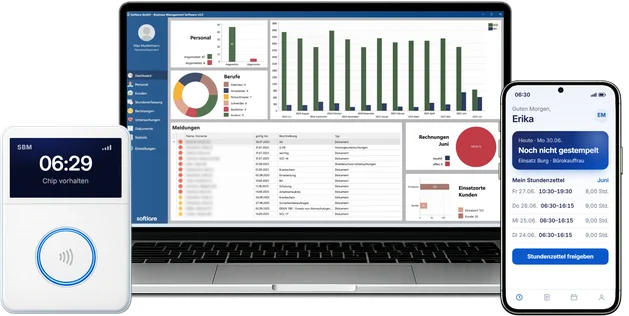
The SBM staffing software automatically splits the hours recorded in the timesheet into Saturday, Sunday, public holiday and night hours, separately for employee and client.
You store the supplements per client, for the night with its own time window, and the public holidays per federal state (Bundesland).
SBM does not produce the payroll itself; the prepared data goes to DATEV or Addison.
The formula is simple – the hours have to be right.
If you store time windows, client rates and public holidays properly once, pay and invoice are calculated from the same hours.
See time tracking in SBMAs of: November 2026. This article provides a general overview and does not replace legal or tax advice. Sources: §§ 2, 6, 7, 11 ArbZG; § 3b EStG; R 3b LStR and H 3b LStH 2026; § 1 SvEV; circular of the central associations of the social security institutions of 22.06.2006 on the treatment of SFN supplements under contribution law (Rundschreiben der Spitzenverbände der Sozialversicherung zur beitragsrechtlichen Behandlung von SFN-Zuschlägen); § 2 EFZG; BAG, 09.12.2015 – 10 AZR 423/14; BAG, 17.01.2018 – 5 AZR 69/17; BAG, 22.02.2023 – 10 AZR 332/20; DGB/GVP framework collective agreement (Manteltarifvertrag) and pay collective agreement (Entgelttarifvertrag), as of January 2026; §§ 7, 8 TV-L as amended by the amending collective agreement (Änderungstarifvertrag) Nr. 14 of 14.02.2026; technical instructions of the Federal Employment Agency on the AÜG (Fachliche Weisungen der Bundesagentur für Arbeit zum AÜG, valid from 01.07.2026).