
 English
 Български
 Deutsch
 Українська
 Magyar
 Română
 Türkçe
 Polski

The e-invoicing obligation takes effect on 1 January 2027 for all businesses that had a total turnover of more than €800,000 in the previous year: from then on, they must issue invoices to domestic businesses as e-invoices. For smaller businesses, this applies from 1 January 2028. All businesses in Germany have had to be able to receive e-invoices since 1 January 2025.
A PDF file sent by email is not an e-invoice. What is required is a structured format such as XRechnung or ZUGFeRD.
This article first gives an overview of the rules, deadlines and formats for all businesses in the B2B sector. It then turns to invoices in temporary agency work (Arbeitnehmerüberlassung), with hours, supplements and records of hours.
What is the e-invoicing obligation? Legal basis and purpose
The e-invoicing obligation (E-Rechnungspflicht) is the duty to invoice supplies between domestic businesses by means of an electronic invoice. It was introduced by the Wachstumschancengesetz (Growth Opportunities Act), which the Bundesrat approved on 22 March 2024.
The Wachstumschancengesetz recast § 14 Umsatzsteuergesetz (UStG, the German VAT Act). The new version has been in force since 1 January 2025 and applies to all supplies carried out after 31 December 2024. The transition periods are set out in § 27 Abs. 38 UStG.
How the tax authorities interpret the rules is set out in three letters from the Bundesministerium der Finanzen (BMF, Federal Ministry of Finance) of 15 October 2024, of 15 October 2025 and of 15 October 2026, and in the BMF’s questions and answers on the introduction of the e-invoice.
The BMF names two aims:
Digitalisation: invoice data do not have to be entered again at the recipient’s end. This avoids duplicated work and errors in invoice processing.
Reporting system (Meldesystem): the e-invoice prepares the ground for a reporting system through which businesses report invoice details to the tax authorities promptly. It is intended to close gaps that allow VAT fraud. The federal government has yet to propose the necessary changes to the law.
In the EU, the “VAT in the Digital Age” (ViDA) package has been in force since 14 April 2025. It provides for digital reporting requirements for cross-border B2B supplies from 1 July 2030. The e-invoicing obligation in Germany applies independently of this and at an earlier date.
E-invoice and “other invoice”: what is the difference?
Since 1 January 2025, the Umsatzsteuergesetz has distinguished between two types of invoice:
E-invoice (electronic invoice, E-Rechnung): it is issued, transmitted and received in a structured electronic format and enables electronic processing. Technically, this is usually an XML file in accordance with the EN 16931 standard.
“Other invoice” (sonstige Rechnung): any invoice on paper or in another electronic format. Other invoices are, for example, PDF invoices without embedded data, image files and emails.
Until the end of 2024, a PDF sent by email also counted as an electronic invoice. This definition now applies only to supplies carried out by 31 December 2024.
| Type of invoice | Structured data | Classification since 2025 |
|---|---|---|
| Paper invoice | no | other invoice |
| PDF invoice by email | no | other invoice |
| XRechnung | yes, pure XML file | e-invoice |
| ZUGFeRD from version 2.0.1 | yes, XML data in the PDF | e-invoice, except in the MINIMUM and BASIC-WL profiles |
For an e-invoice, “readable” means machine-readable. An additional document for the human eye is allowed but not required.
„Eine elektronische Rechnung ist eine Rechnung, die in einem strukturierten elektronischen Format ausgestellt, übermittelt und empfangen wird und eine elektronische Verarbeitung ermöglicht.“ [An electronic invoice is an invoice that is issued, transmitted and received in a structured electronic format and that enables electronic processing.]
Who does the e-invoicing obligation apply to? Domestic B2B supplies
The e-invoicing obligation concerns domestic B2B supplies (business-to-business): one business makes a supply to another business for the purposes of that business, and both are established in Germany.
A business (Unternehmer) is anyone who independently carries out a commercial or professional activity (§ 2 UStG), which also includes freelancers, landlords and small businesses (Kleinunternehmer).
Established in Germany means a business that has its registered office, its management or a fixed establishment involved in the supply in Germany.
Not covered are invoices to private consumers (B2C) and invoices where one side is not established in Germany.
The rules also apply to B2B invoices where the recipient of the supply owes the tax (§ 13b UStG).
Separate rules apply in addition to invoicing public-sector clients; at federal level this is the E-Rechnungsverordnung (ERechV, the federal e-invoicing regulation).
Exceptions to the e-invoicing obligation
The e-invoicing obligation presupposes that there is an obligation under VAT law to issue an invoice at all. It therefore does not apply to invoices to consumers or to supplies that are tax-exempt under § 4 Nr. 8 bis 29 UStG.
Even where an invoice is mandatory, an “other invoice” remains permanently permitted in four cases:
Low-value invoices (Kleinbetragsrechnungen) with a total amount of up to €250 (gross), § 33 UStDV
Passenger tickets (Fahrausweise) that count as invoices, § 34 UStDV
Invoices from small businesses, § 34a UStDV
Invoices to legal entities that are not businesses, for example many associations and public bodies
For the €250 threshold, only the total amount of the invoice counts.
The exceptions concern issuing only. Small businesses, too, must be able to receive e-invoices.
Anyone who may use an exception can still issue an e-invoice. Between domestic businesses, this is possible without the recipient’s consent.
E-invoicing obligation: what applies from when?
The e-invoicing obligation for B2B supplies is being introduced in stages. Receiving has been mandatory since 1 January 2025; transition periods apply to issuing (§ 27 Abs. 38 UStG). Regardless of the format, an invoice must be issued within six months of the supply.
The deadlines at a glance:
Since 1 January 2025: every domestic business must be able to receive e-invoices. An email inbox is sufficient for this. There are no exceptions.
Until 31 December 2026: issuers may still use paper invoices or, with the recipient’s consent, another electronic format such as PDF.
From 1 January 2027: anyone who had a total turnover of more than €800,000 in the previous year must issue e-invoices. For 2027, it is therefore the turnover of 2026 that counts.
From 1 January 2028: the obligation applies to everyone, including businesses with a previous-year turnover of up to €800,000. At the same time, the transition period ends for EDI procedures that do not meet the requirements for an e-invoice.
The recipient’s consent to another electronic format does not require any particular form. It can be set out in the general terms and conditions or be given tacitly if the client accepts PDF invoices without objection.
No postponement of these dates has been decided. § 27 Abs. 38 UStG applies unchanged, and the BMF again took the transition periods as its basis in its letter of 15 October 2026.
Who must issue e-invoices from 2027?
What matters is the total turnover of the previous year (§ 19 Abs. 2 UStG). If it is above €800,000, the transition period ends on 31 December 2026. In a VAT group (umsatzsteuerliche Organschaft), the turnover of the entire group counts.
In temporary agency work, this threshold is reached quickly. A worked example: 15 assigned employees, each with 150 hours a month and a charge rate of €32, add up to €864,000 a year.
Businesses above the threshold must issue e-invoices from 1 January 2027, all other businesses in B2B trade one year later.
Caution: invoicing for December 2026The transitional rule requires that the invoice is transmitted by 31 December 2026. Anyone who does not invoice the assignments from December 2026 until January 2027 can, according to the wording of § 27 Abs. 38 UStG, no longer rely on it. Clarify the turn of the year with your tax adviser at an early stage.
Receiving e-invoices: mandatory since 1 January 2025
Since 1 January 2025, the following has applied: all domestic businesses must be able to receive e-invoices. For receiving e-invoices there is no transition period and no exception, not even for small businesses.
No consent needed: the issuer no longer needs the recipient’s consent for an e-invoice. Your suppliers may therefore already send you e-invoices today.
Technology: an email inbox is sufficient for receiving. Other channels can be agreed.
Display: an XRechnung does not contain a PDF. To read it, you need a viewer program. The tax authorities provide an e-invoice viewer via the ELSTER portal.
Processing: you do not have to process the data further automatically. However, you must accept the e-invoice, check it and keep it in its original form.
XRechnung and ZUGFeRD: what is the difference?
A permitted format must comply with the European standard for electronic invoicing, the EN 16931 series of standards. The EN 16931 standard prescribes an XML format and now also applies in the B2B sector. A simple PDF does not meet the requirements.
In Germany, XRechnung and ZUGFeRD are the common formats:
XRechnung: a purely structured format, an XML file. It is intended for machines. To read it, you need a viewer program. The standard is developed by the Koordinierungsstelle für IT-Standards (KoSIT, the coordination office for IT standards).
ZUGFeRD: a hybrid format. A PDF file additionally contains the XML data. ZUGFeRD is permitted from version 2.0.1, except for the MINIMUM and BASIC-WL profiles. The format is developed by the Forum elektronische Rechnung Deutschland (FeRD).
EDI and other formats: issuer and recipient can agree on another structured format if the mandatory details can be converted correctly and completely into a format that complies with the standard or into one that is interoperable with the standard.
In a hybrid format, the structured part has been decisive since the introduction of the e-invoicing obligation. If the XML data and the PDF image differ, the XML data apply.
Validation shows whether a file meets the requirements of the EN 16931 standard. The BMF recommends it as early as when the invoice is created and sent. If a file has a format error, it is not an e-invoice but an “other invoice”.
The contracting parties agree which permitted format they use.
Transmission: how does the e-invoice reach the client?
The law does not prescribe a particular transmission channel. The BMF mentions these options:
dispatch by email
provision via an electronic interface
download via an internet portal
shared access to a central storage location within a corporate group
handover on a data carrier, for example a USB stick
The contracting parties agree which channel they use. A Leitweg-ID is not needed in the B2B sector.
The channels may change with the planned reporting system: the BMF expects e-invoicing platforms to be of importance for the exchange of invoices and intends to redefine the permitted transmission channels as part of the reporting system.
Archiving: keeping e-invoices correctly
Incoming and outgoing invoices must be kept for eight years (§ 14b Abs. 1 UStG). The period begins at the end of the calendar year in which the invoice was issued. Until the end of 2024 it was ten years; the Viertes Bürokratieentlastungsgesetz (Fourth Bureaucracy Relief Act) shortened the period.
These requirements apply to e-invoices:
Original form: at least the structured part must be available intact in its original form. A printout or the PDF image alone is not enough.
Machine-evaluable: the tax authorities must be able to evaluate the data by machine.
GoBD: for bookkeeping, the GoBD apply, the BMF’s principles on keeping records in electronic form.
In July 2026, the Bundesministerium der Finanzen announced that it intends to extend the retention period for accounting vouchers (Buchungsbelege) to 15 years. The law still says eight years. Check the current period before you delete invoice data.
Credit notes (Gutschriften), corrections and interim invoices
The e-invoicing obligation also applies to credit notes within the meaning of the Umsatzsteuergesetz (Gutschriften, i.e. self-billing). These are invoices that the recipient of the supply issues itself by prior agreement (§ 14 Abs. 2 Satz 5 UStG). For the €800,000 threshold, it is then the recipient’s total turnover that counts.
The commercial credit note (kaufmännische Gutschrift), which businesses use in practice to correct their own invoices, is something different. Corrections are subject to the same requirements as to form and content as the invoice itself. This results in the following rules:
If the e-invoicing obligation applies, the correction must also be an e-invoice and refer clearly to the original invoice.
Which invoice type is to be used for which kind of correction has not yet been technically specified. The BMF currently accepts any kind that works in practice, provided that the invoice and the correction together clearly show the correct details.
During the transition periods, an invoice can still be corrected without an e-invoice.
A cash discount (Skonto) only reduces the taxable amount; the invoice does not have to be corrected for this. If the scope of the service changes, for example because hours are corrected afterwards, a correction is in principle necessary.
Interim invoices (Abschlagsrechnungen) that a business issues before its effective date do not have to be e-invoices, even if the service and payment only follow afterwards.
What happens if no e-invoice is issued?
In the view of the tax authorities, there is currently no risk of a fine: anyone who issues an “other invoice” despite the obligation does not commit an administrative offence under § 26a UStG. Nevertheless, it is not without consequences.
The client’s input VAT deduction: an “other invoice” is then not a proper invoice and in principle does not entitle the client to deduct input VAT. It can be corrected by a subsequent e-invoice.
The client’s claim: the recipient of the service has a claim under civil law to an e-invoice.
Receipt: if a client cannot accept an e-invoice, it has no claim to another form of invoice. The issuer has fulfilled its obligation if it has issued an e-invoice and has demonstrably made an effort to transmit it.
E-invoices in temporary agency work: hours, supplements, records
Invoices in temporary agency work have many line items: hours per employee, supplements for night, Sunday and public holiday work, often also travel costs or flat rates. The basis is the timesheet (Stundenzettel) confirmed by the client. Four rules apply to the e-invoice here:
Mandatory details in the data part
All mandatory details under VAT law must be in the structured part. A reference to an attachment is not sufficient for this.
Records of hours as an attachment
Supplementary details may go into an embedded attachment. As an example, the BMF expressly mentions the breakdown of records of hours in a PDF file.
Collective invoice per month
The calendar month may be stated as the date of supply (§ 31 Abs. 4 UStDV). Several supplies in a month can thus be included in a single e-invoice.
Correction as an e-invoice
If the e-invoicing obligation applies, the correction must also be made as an e-invoice, with a clear reference to the original invoice.
The description of the service in the data part must make the service clearly identifiable: type, scope and, where applicable, place. Not every detail belongs in it. For an invoice for temporary agency work, the following is a good approach: line items with activity, period, number of hours, hourly rate and type of supplement in the data part, plus the confirmed record of hours as an embedded attachment.
Industry supplements (Branchenzuschläge) and Equal Pay can change the charge rate in the course of an assignment. Contract data and invoice line items should therefore come from the same source.
Many clients also require details of their own, such as an order number, cost centre or a buyer reference. In an XRechnung, the field “Buyer reference” (BT-10) is a mandatory field of the format. Ask every client for these details before the first e-invoice.
Introducing e-invoicing: checklist for staffing providers
These points should be clarified before the effective date:
FAQ on the e-invoicing obligation
There is none. E-invoice (E-Rechnung) is the short form for the electronic invoice within the meaning of § 14 UStG. Since 1 January 2025, only an invoice in a structured electronic format has counted as an electronic invoice.
It is intended to digitalise invoicing and to prepare a reporting system with which the tax authorities can detect VAT fraud more quickly. The legal basis is § 14 UStG as amended by the Wachstumschancengesetz.
Domestic businesses have had to receive e-invoices since 1 January 2025. Businesses with a previous-year turnover of more than €800,000 must issue them from 1 January 2027, all others from 1 January 2028 (§ 27 Abs. 38 UStG).
No. A simple PDF has no structured format and has been classed as an “other invoice” since 2025. A ZUGFeRD PDF with embedded XML data, by contrast, is an e-invoice.
No, not for supplies between domestic businesses. The recipient’s consent is only needed for “other invoices” in an electronic format, for example for PDF invoices during the transition periods.
Not for issuing: invoices from small businesses may always be transmitted as an “other invoice” (§ 34a UStDV). However, like all businesses, small businesses must be able to receive e-invoices.
No. It only concerns invoices in the B2B sector where both businesses are established in Germany. In the other cases, paper invoices and, with consent, PDF invoices remain permitted.
Both formats are permitted. ZUGFeRD additionally contains a PDF that people can read without an extra program. Which format a client can process or specifies varies. What counts is the agreement with the client.
Yes, as an embedded attachment to the e-invoice. The mandatory details and a clear description of the service must, however, be in the structured part (BMF letters of 15 October 2025 and of 15 October 2026).
No. A Leitweg-ID is only needed if the invoice goes to a public authority.
In the view of the tax authorities, not at present. However, the client can demand an e-invoice, and an “other invoice” in principle does not allow the client to deduct input VAT.
The e-invoice is a question of data, not of the PDF layout.
Anyone who keeps hours, supplements and client data in structured form has completed the largest part of the changeover. What then remains open is the format and transmission channel per client.
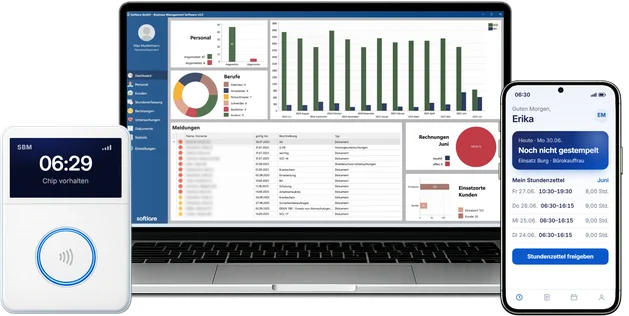
The SBM staffing software creates invoices from the timesheet and outputs them as ZUGFeRD 2.3 in the XRechnung profile: XML data embedded in a PDF/A-3b. Dispatch is by email via Outlook; pure XML dispatch, for example via Peppol, is currently not part of the range of functions.
From time tracking to the invoiceAs of: November 2026. This article provides a general overview and does not replace tax or legal advice. Sources: §§ 2, 13b, 14, 14b, 19, 27 Abs. 38 UStG; §§ 31, 33, 34, 34a UStDV; Wachstumschancengesetz (BGBl. 2024 I Nr. 108); BMF letters of 15.10.2024, 15.10.2025 and 15.10.2026 on the introduction of mandatory electronic invoicing; BMF, questions and answers on e-invoicing (as of 29.10.2026); BMF, Aktionsplan gegen Steuer- und Finanzkriminalität (action plan against tax and financial crime, July 2026); European Commission, VAT in the Digital Age (ViDA).